


Pros And Cons Of Using Surgical Drape Folding Machines In Healthcare
Every disposable surgical drape that reaches a hospital operating room was once a roll of non-woven fabric. The machine that transforms that raw material into a precisely folded, sterile-ready product is a surgical drape folding machine — and the decision to invest in one, or not, is one of the most consequential choices a healthcare manufacturer can make. This guide examines both sides of that decision with clarity and depth.
Key Takeaways
Surgical drape folding machines dramatically increase output consistency and volume compared to manual production, but require meaningful upfront capital investment.
Full-servo drive systems lower long-term maintenance costs and enable fast product changeovers — a major operational advantage for multi-SKU producers.
Machine precision directly influences whether finished drapes meet standards such as EN 13795 and ISO 13485.
The disposable surgical drapes market reached approximately USD 1.40 billion in 2024 and continues to grow, driven by rising surgical volumes and tightening infection-control protocols worldwide.
Understanding both the pros and the cons allows facilities and manufacturers to make smarter, better-timed investment decisions.
Why This Topic Matters in Healthcare Today
Disposable surgical drapes are sterile barriers that separate the surgical site from potential sources of contamination. Their role in preventing healthcare-associated infections (HAIs) is well established and endorsed by major global health authorities, including the World Health Organization and the U.S. Centers for Disease Control and Prevention (CDC). As the global volume of surgical procedures continues to rise, so does the demand for reliable, high-quality drapes — and that demand flows directly back to how those drapes are manufactured.
The shift from reusable fabric drapes to single-use disposable versions has accelerated steadily. Disposable drapes eliminate the sterilization cycles, laundering infrastructure, and contamination risk associated with reusable textiles. For manufacturers, this creates a growing and accessible market — provided the production process itself is up to the task.
That is where the surgical drape folding machine enters the picture. But like any major piece of capital equipment, it comes with genuine advantages and real limitations. Here is an honest, complete look at both.
What Is a Surgical Drape Folding Machine?
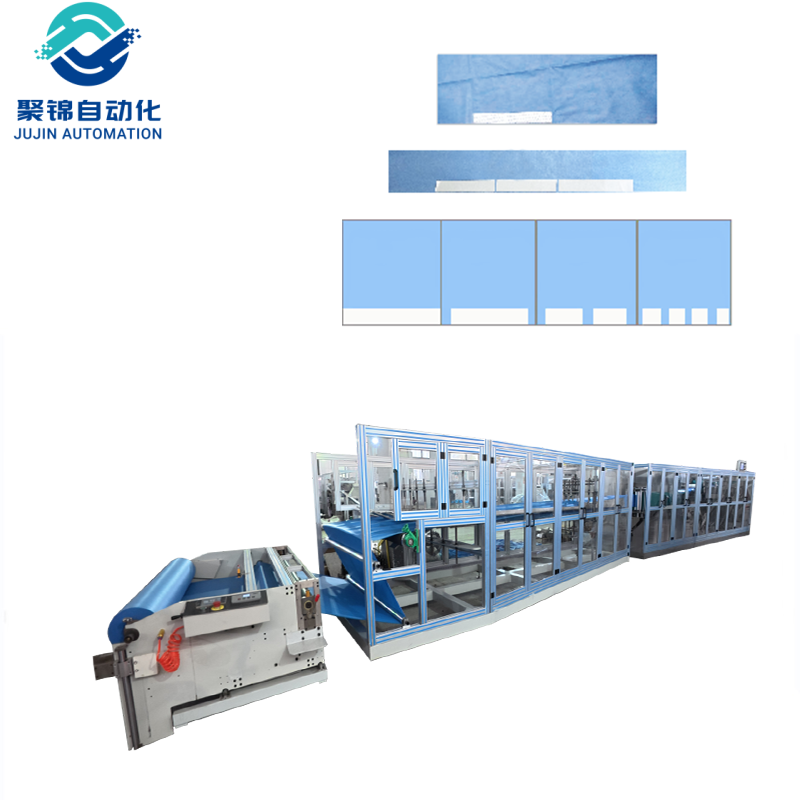
A surgical drape folding machine is automated converting equipment that takes wide rolls of non-woven fabric — typically polypropylene-based SMS (Spunbond-Meltblown-Spunbond) material — and processes them into finished, multi-folded surgical drapes through a continuous, unmanned production cycle. The machine handles material unwinding, tension control, longitudinal folding, lateral folding, cutting to length, and transfer to a packing station.
Modern machines of this type use full-servo drive systems — electronically controlled motors that replace traditional mechanical cams and gears. This means each motion is programmable, reproducible, and adjustable via a touchscreen control panel, without physical retooling of the machine.
A closely related machine type is the adhesive drape making machine, which adds a rotary hole-cutting module and a double-sided tape applicator to produce fenestrated drapes — those with a pre-cut opening surrounded by a medical-grade adhesive border. Both machine types share the same fundamental folding architecture and are often discussed together when healthcare manufacturers assess their production options.
The Pros: Where Surgical Drape Folding Machines Deliver Real Value
Key Advantages
Consistent output at scale
Drastic reduction in labor costs
Precision folding for compliance
Fast product changeovers
Lower contamination risk vs. manual handling
High-speed capability (up to 60–70 m/min)
Scalable to production growth
Key Drawbacks
High upfront capital cost
Significant floor space required
Operator training needed
Downtime risk if maintenance is neglected
Not cost-effective for very low volumes
Spare parts must be managed proactively
Pro 1: Dramatically Higher and More Consistent Output
The most immediate benefit of a surgical drape folding machine is volume. A modern full-servo machine running at a stable rate can produce approximately 15 finished drapes per minute — around 5,400 pieces in a single 6-hour production shift. No manual folding operation can approach that pace, and — crucially — no manual process can approach that level of dimensional consistency across thousands of pieces.
In medical device manufacturing, consistency is not just a quality preference — it is a regulatory requirement. Drapes that vary in fold dimensions, edge alignment, or cut length will fail quality inspections and cannot be sterile-packaged reliably. The machine removes this variability from the equation.
Pro 2: Major Reduction in Labor Costs
Manual drape folding requires multiple operators per shift, each performing repetitive, physically demanding tasks with inherent inconsistency. Automated equipment replaces this workforce requirement with one or two machine operators responsible for material loading, quality monitoring, and output transfer. Over a full year of operation, the labor cost savings alone typically represent a significant portion of the machine's purchase price.
For manufacturers in higher-wage markets, this equation is particularly compelling. For those in lower-wage markets, the argument shifts toward output volume and consistency — but the economic case remains strong in either direction.
Pro 3: Precision That Supports Regulatory Compliance
Surgical drapes are classified as medical devices in most regulatory frameworks. They must meet performance standards — including ISO 13485 for quality management and EN 13795 for barrier performance — that depend directly on dimensional accuracy and process repeatability. The WHO's global guidelines on surgical site infection prevention further reinforce why drape quality is a genuine clinical concern, not merely a commercial one.
This type of equipment with active Edge Position Control (EPC) maintains material alignment to within ±3 mm across the full production width, delivering the dimensional repeatability that audit trails and quality management systems require.
Pro 4: Flexible Product Changeovers
Producers who manufacture multiple drape sizes or specifications benefit enormously from the touchscreen HMI systems found on modern automated folding machines. Saved product recipes allow operators to switch from one drape format to another in under 10 minutes — no mechanical adjustment, no specialist intervention. This flexibility makes a single machine capable of serving a diverse product portfolio, which is essential for small to medium-scale producers building a varied customer base.
Pro 5: Reduced Contamination Risk in Production
Manual handling introduces a contamination pathway that automated production eliminates. When operators handle non-woven fabric repeatedly throughout a shift, there is an ongoing risk of particulate contamination from skin, hair, and clothing. Automated folding equipment minimises human contact with the material between unwinding and final folding, significantly reducing this risk in the manufacturing environment — an important consideration for facilities pursuing clean room or controlled environment certifications.
Pro 6: Scalability Without Line Redesign
A well-specified machine grows with the business. Adding a second shift doubles output without adding a second machine. Upgrading from a single-line operation to a two-machine facility can be planned in advance with the factory layout, electrical supply, and material handling systems already designed to accommodate the expansion. This scalability path is far cleaner than trying to scale a manual operation, which requires proportional growth in headcount, supervision, and quality control.
The Cons: Honest Limitations to Consider
Con 1: High Upfront Capital Cost
A full-servo automated drape machine represents a substantial capital investment. The price varies significantly based on configuration, raw material width capacity, and additional modules (such as adhesive application or hole cutting), but prospective buyers should budget accordingly and model the return on investment against projected production volumes and labor savings before committing. For operations producing very low volumes — say, a few hundred drapes per day — the economics may not justify the machine at the outset.
Con 2: Significant Floor Space Requirement
The full-servo folding model requires approximately 14.4 m in machine length and 2.5 m in width, plus clearance space on all sides for safe operation and maintenance access. This is a substantial footprint that many smaller facilities cannot easily accommodate. The adhesive drape machine variant is more compact at approximately 6.6 m × 4.4 m — but both require advance factory planning. Producers who underestimate this requirement find themselves with equipment that cannot be properly installed or maintained.
Con 3: Operator Training and Technical Literacy
Full-servo machines with touchscreen HMI controls are not difficult to operate once training is complete — but the training phase is real. Operators need to understand parameter setting, fault reading, basic troubleshooting, and the machine's material requirements. Facilities without an existing technical training culture may find the ramp-up period longer than expected. Reputable manufacturers address this through detailed video documentation, English-language manuals, and on-site commissioning support — but buyers should confirm this is included before purchasing.
Con 4: Maintenance Dependency
Any automated production line that stops unexpectedly stops all output. While full-servo machines have significantly fewer mechanical wear components than older cam-and-gear designs, they are still complex equipment. Cutting dies, conveyor belts, sensor components, and tensioning systems require scheduled inspection and replacement. Facilities without a proactive maintenance culture — or without ready access to spare parts — can experience costly unplanned downtime. Buyers sourcing from overseas manufacturers should confirm spare parts availability and international shipping lead times before signing a purchase agreement.
Con 5: Not Ideal for Very Low Volume or Highly Bespoke Production
For producers who manufacture extremely small batches — for example, custom drapes for a single specialist surgical team — the economics and setup time of a surgical drape folding machine may not make sense. Highly bespoke drape configurations that change with every order are also more challenging to accommodate than standardised product families. In these niche cases, semi-automated or manual production may remain more practical.
Side-by-Side: Machine vs. Manual Production
| Factor | Surgical Drape Folding Machine | Manual Production |
|---|---|---|
| Output (pieces/shift) | ~5,000–6,000+ | 300–800 (highly variable) |
| Dimensional consistency | Excellent (±3 mm tolerance) | Poor to moderate |
| Labor requirement | 1–2 operators per machine | 4–10+ workers per line |
| Capital cost | High (significant upfront investment) | Low (minimal equipment) |
| Regulatory compliance support | Strong (process repeatability) | Challenging (high variability) |
| Contamination risk | Low (minimal human contact) | Higher (repeated handling) |
| Changeover time | Under 10 min (HMI recipe recall) | Varies (retooling required) |
| Scalability | Add shifts or machines with minimal disruption | Requires proportional headcount growth |
| Best suited for | Small to large scale, multi-SKU, compliant production | Very low volume, bespoke, or startup testing |
How Machine Features Affect the Pros and Cons Balance
Not all drape folding machines are equal. The features a machine includes directly shape whether its advantages outweigh its drawbacks in a given operation. Here is how the key technical choices affect the overall balance:
Full-Servo vs. Mechanical Drive
Full-servo drive systems replace mechanical cams and gears with electronically controlled motors. This dramatically reduces mechanical wear, speeds up changeovers (no physical retooling), and improves dimensional accuracy. It also raises the machine's initial cost — but lowers long-term maintenance costs enough that the total cost of ownership over a 5-year period typically favours full-servo by a meaningful margin.
EPC (Edge Position Control)
Active web-guiding systems detect and correct lateral drift in real time, maintaining material alignment throughout the production run. Without EPC, even a small initial misalignment compounds over thousands of metres of material, resulting in out-of-spec finished products and wasted non-woven fabric. EPC is not a luxury feature — it is a prerequisite for reliable medical-grade output.
Automatic Tension Control
Non-woven fabrics stretch under inconsistent feed tension, causing dimensional variation in the finished drape and increasing material breakage rates. Automatic cylinder-driven tension control systems regulate feed force continuously, enabling smooth material flow at any production speed. This feature directly reduces material waste — a significant ongoing cost in drape production.
Touchscreen HMI with Recipe Memory
The ability to save and recall complete parameter sets for each product type is what makes a single surgical drape folding machine commercially viable for a multi-SKU operation. Without this capability, switching between drape formats becomes a lengthy, error-prone manual process that erodes the machine's efficiency advantage.
Who Benefits Most from a Surgical Drape Folding Machine?
| Producer Type | Expected Benefit Level | Key Consideration |
|---|---|---|
| Small-scale (1 shift/day, 1–3 SKUs) | High — replaces manual labor, enables compliance | Choose compact footprint; prioritise HMI flexibility |
| Medium-scale (2 shifts/day, 3–8 SKUs) | Very high — ROI typically 18–36 months | Full-servo model with recipe memory is essential |
| Surgical pack assembler | High — consistent drape quality feeds pack quality | Adhesive model adds fenestrated drape capability |
| OEM supplier to hospitals | High — output volume and audit-ready consistency | ISO 13485 process documentation starts at machine level |
| Startup / pilot operation | Moderate — capital cost is significant barrier | Model payback carefully before committing |
| Very low volume / bespoke | Low — manual may remain more practical | Consider semi-automated entry path instead |
Total Cost of Ownership: A Realistic View
One of the most common errors buyers make is comparing purchase prices in isolation. The true cost of a surgical drape folding machine — or of not having one — includes several components beyond the invoice price.
Energy Costs
A machine rated at 7.5–8 kW operating power running two 8-hour shifts per day costs approximately USD 14–16 per day in electricity at typical industrial rates (around USD 0.12/kWh). Over a full year, this amounts to roughly USD 4,000–5,000 — a manageable and predictable operational cost.
Maintenance and Spare Parts
Full-servo machines consume far fewer mechanical wear components than older gear-driven designs. The main consumable items are cutting dies (for adhesive models with hole cutters), conveyor belts, and sensor components. These should be stocked locally or sourced quickly from the manufacturer. Buyers should confirm the supplier's spare parts availability and international shipping policy before purchase.
Training and Ramp-Up
On-site commissioning support from the manufacturer shortens the ramp-up period from potential months to a matter of weeks. Video tutorials and English-language documentation address day-to-day operator questions. Buyers who invest in proper initial training avoid the extended productivity losses that characterise self-managed installations.
Quality and Compliance Cost Avoidance
This is perhaps the most underappreciated element of the cost equation. Production that consistently meets dimensional specifications results in near-zero rejection rates at quality inspection. Manual production, by contrast, typically generates reject rates of 3–8% or higher — wasted material, wasted labor, and potential compliance failures that can have far greater business consequences than any machine cost.
Summary: When all cost elements are considered together — purchase price, energy, maintenance, training, material waste, and compliance risk avoidance — a full-servo automated drape machine consistently delivers a stronger total cost of ownership than manual production at any volume above a few hundred pieces per day.
Regulatory and Standards Context
Healthcare manufacturers producing disposable surgical drapes operate within a defined regulatory framework. Understanding how machine selection feeds into compliance is not optional — it is foundational.
EN 13795 — the European standard for surgical drapes used as medical devices — specifies barrier performance, cleanliness, and mechanical strength requirements. Meeting this standard requires a production process that delivers consistent, repeatable results across every unit produced. A well-configured folding machine with full-servo control and active web-guiding is the practical foundation for that consistency.
ISO 13485 — the internationally recognised quality management framework for medical device manufacturing — applies to the producer's factory system, not directly to the machine. But machine precision and process documentation are foundational elements of any ISO 13485 audit. A machine that produces variable results creates audit evidence that directly undermines certification efforts.
Regulatory requirements also vary by export destination. European markets require CE marking; the US market requires FDA 510(k) clearance or registration; other markets have their own frameworks. A knowledgeable machine supplier should be familiar with these requirements and able to support the buyer's compliance documentation process from the outset.
Looking for a Reliable Surgical Drape Folding Machine Factory?
JUJIN engineers work directly with small and medium-scale producers to identify the right surgical drape machine configuration for their product mix, output targets, and compliance requirements — with no middlemen involved.
Factory-direct pricing · 12-month warranty · On-site installation support available · Global shipping
Making the Decision: A Practical Framework
For healthcare manufacturers weighing the pros and cons of a surgical drape folding machine, the following questions provide a structured starting point.
| Question | If Yes → | If No / Unsure → |
|---|---|---|
| Is target daily output above ~500 drapes/day? | Machine investment is likely justified | Model the economics more carefully first |
| Are consistent dimensions required for compliance? | Full-servo machine with EPC is necessary | Confirm regulatory obligations for target market |
| Does the facility have 15+ m of available floor length? | Standard folding model fits comfortably | Consider compact adhesive model instead |
| Will multiple drape formats be produced? | Touchscreen HMI with recipe memory is essential | Basic machine may suffice for single-SKU lines |
| Is fenestrated adhesive drape production needed? | Adhesive drape machine is the right choice | Standard folding machine meets the requirement |
Summary
The pros and cons of surgical drape folding machines in healthcare are not abstract — they are specific, measurable, and decision-relevant. The advantages are substantial: dramatically higher output, consistent dimensional quality, regulatory compliance support, lower labor cost, reduced contamination risk, and genuine scalability. The disadvantages are real but manageable: capital cost, floor space, training requirements, and maintenance discipline.
For any manufacturer producing disposable surgical drapes at more than micro-scale volumes, the case for a surgical drape folding machine is strong. The case becomes even stronger when the machine is chosen carefully — with full-servo drive, EPC web-guiding, automatic tension control, and a touchscreen HMI — and sourced from a specialist manufacturer who understands the medical device production environment from the ground up.
For producers who want to work with a specialist rather than a generalist equipment supplier, JUJIN manufactures both full-servo folding machines and adhesive drape making machines at its Changzhou, China facility, shipping globally with full export packaging, English documentation, and commissioning support.


