


Best Surgical Drape Making Machine For Small To Medium-scale Production
The global surgical drapes market is on a clear upward trajectory — valued at over USD 1.4 billion in 2024 and growing steadily as hospitals worldwide push for tighter infection control. For manufacturers starting or scaling a medical consumables business, picking the right surgical drape making machine is one of the most consequential decisions they will make. Get it right and the line runs reliably for years. Get it wrong and costly downtime, material waste, and quality failures follow.
This guide breaks down exactly what small to medium-scale producers need to know — from machine types and core features to compliance requirements and a side-by-side comparison of the two main production setups — so the decision becomes straightforward rather than overwhelming.
Two primary machine types exist for this scale: the surgical drape folding machine and the adhesive drape making machine — each suited to different product outputs.
Full-servo drive systems deliver significantly better precision and lower long-term maintenance costs than older gear-and-cam designs.
Touchscreen HMI controls allow product changeovers without mechanical adjustments, which is critical for small-batch flexibility.
Compliance with international standards such as EN 13795 begins at the machine level — the equipment's consistency directly affects the final product's certifiability.
A production speed of 60 m/min or higher is achievable on modern equipment without sacrificing folding accuracy.
Factory-direct sourcing from a specialist manufacturer reduces cost and speeds up technical support versus buying through a trading company.
Why Surgical Drape Production Is a Growing Opportunity
Disposable surgical drapes are single-use sterile barriers placed over the patient and surrounding equipment during surgery. Their core job is simple: block the path between potential sources of contamination and the open surgical site. Because of this critical function, their use is now embedded in surgical safety protocols endorsed by major global health bodies including the World Health Organization and the U.S. Centers for Disease Control and Prevention (CDC).
The shift away from reusable fabric drapes toward single-use disposable versions has been accelerating. Reusable drapes require sterilization cycles, laundering infrastructure, and ongoing inspection — all of which add operational complexity. Disposable drapes, produced from non-woven materials, eliminate that burden entirely. They leave the factory sterile-ready, reducing setup time in the operating room and removing the risk of cross-contamination from improperly processed reusable textiles.
For a small to medium-scale producer, this market trend is an opportunity. Demand is rising, the raw materials (non-woven polypropylene fabric) are accessible globally, and the barrier to entry — choosing the right surgical drape making machine — is entirely manageable with the right information.
The Two Main Types of Surgical Drape Making Machine
Before comparing features, it helps to understand the two distinct machine types that dominate this production segment. They are not interchangeable — they are designed for different end products, though some overlap exists.
Type 1 — Surgical Drape Folding Machine
This machine takes wide rolls of non-woven fabric (typically up to 2,000 mm wide) and processes them into flat, multi-folded surgical drapes ready for sterile packaging. The workflow runs from roll feeding through longitudinal folding, lateral folding, and final cutting into individual sheets.
A quality folding machine is the foundation of any drape production line. It handles standard surgical sheets, O-drapes, isolation drapes, and similar products used across general surgery, orthopaedics, and outpatient settings.
Ideal for: Producers supplying hospitals with high-volume standard drape SKUs, or those building a drape manufacturing line from scratch.
Type 2 — Adhesive Drape Making Machine
An adhesive drape making machine does everything a folding machine does, but adds two critical modules: a center hole cutter and a double-sided tape applicator. Together, these allow the machine to produce fenestrated drapes — drapes with a pre-cut opening surrounded by a medical-grade adhesive border that adheres directly to the patient's skin during the procedure.
These are the drapes used in ophthalmic surgery, cardiovascular procedures, orthopaedic interventions, and dental surgery, among others. They command a higher per-unit value than standard flat drapes and are often part of custom surgical packs.
Ideal for: Producers targeting specialty medical facilities, surgical pack assemblers, or export customers with specific fenestrated drape requirements.
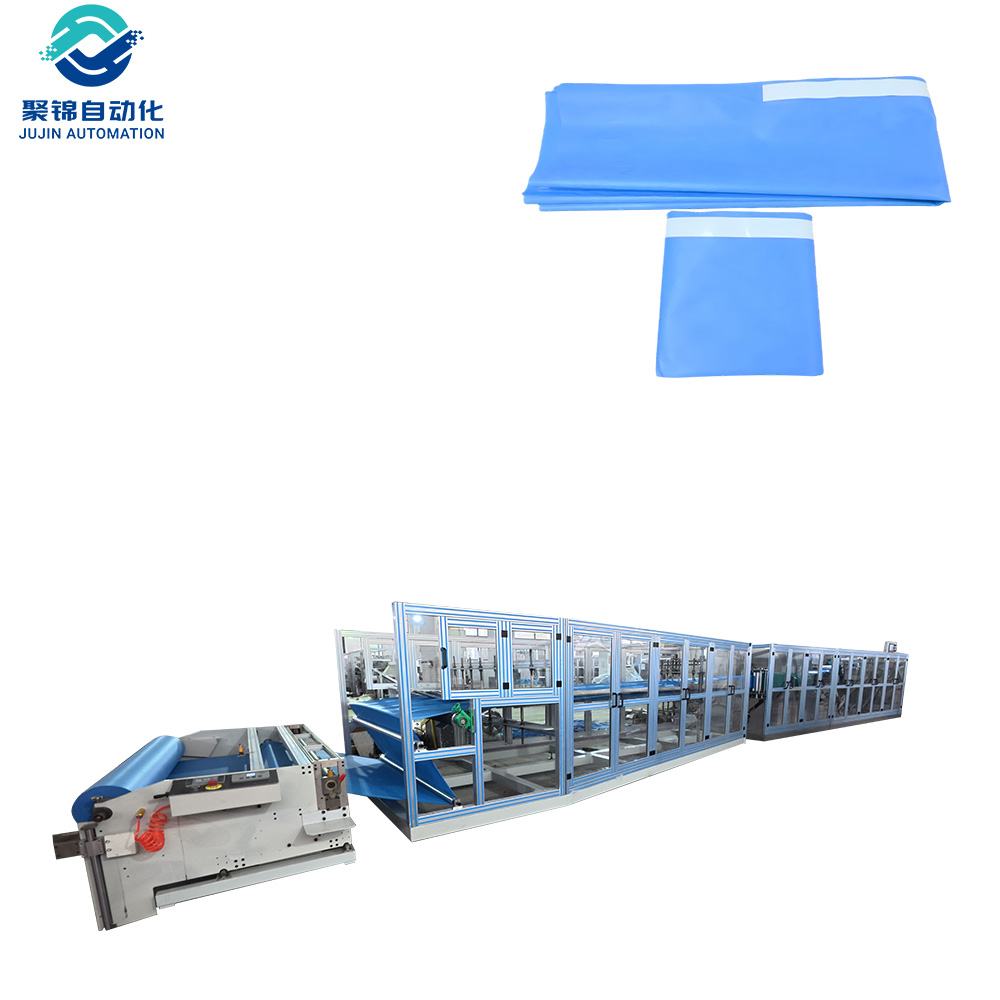
Folding Machine vs. Adhesive Drape Machine: Side-by-Side
| Feature / Factor | Surgical Drape Folding Machine | Adhesive Drape Making Machine |
|---|---|---|
| Primary Output | Standard flat surgical drapes | Fenestrated (hole) drapes with adhesive border |
| Key Additional Modules | — | Rotary hole cutter + double-sided tape applicator |
| Max Raw Material Width | Up to 2,000 mm | Up to 1,200 mm |
| Finished Product Length | ≤ 1,000 mm | ≤ 1,100 mm |
| Fold Pattern | 4-fold horizontal | 3-fold horizontal |
| Production Speed | Customisable per order volume | Up to 60 m/min stable output |
| Control System | Full-servo + touchscreen HMI | Full-servo + touchscreen HMI |
| Power Consumption | 7.5 kW total | 11 kW total (8 kW operating) |
| Target Product Category | General surgery, isolation, procedure sheets | Ophthalmic, cardiovascular, orthopaedic, dental drapes |
| Machine Footprint | ~14.4 m × 2.5 m | ~6.6 m × 4.4 m |
5 Features That Separate a Good Machine from a Great One
Spec sheets can be deceiving. Two machines may list similar speeds or widths, but the underlying engineering can be worlds apart. Here are the five features that matter most for small to medium-scale producers who need reliable daily output without a large maintenance team.
1. Full-Servo Drive System
Older folding machines use mechanical cams and gears to drive the folding and cutting motions. These work, but they require frequent mechanical adjustments as parts wear, and changing product sizes often means physical retooling of the machine — a process that can take hours.
A full-servo drive system replaces these mechanical linkages with electronically controlled servo motors. Each motion is programmable and reproducible with millimetre-level accuracy. When a product size changes, the operator updates parameters on the touchscreen — no spanner required. For small-scale producers running multiple SKUs, this is not a luxury; it is a necessity.
2. EPC Edge Position Control
Non-woven fabric rolls are not perfectly wound. As the material unwinds at speed, it will naturally drift laterally — sometimes by several millimetres. On a machine without active correction, this drift accumulates and results in drapes with uneven edges, off-centre folds, and out-of-spec dimensions.
EPC (Edge Position Control) is an automatic web-guiding system that detects lateral drift in real time and corrects it continuously. On a well-configured system, the tolerance is held to approximately ±3 mm across the full material width. This directly translates to consistent finished product dimensions — a non-negotiable requirement for medical-grade output.
3. Automatic Tension Control
Non-woven fabric is sensitive to pulling forces. If material is fed under inconsistent tension, it stretches unevenly, causing dimensional variation in the finished drape and increasing the rate of material breakage — both of which generate waste and downtime.
Cylinder-driven automatic tension control systems regulate the feed force continuously without operator intervention. The result is smooth, consistent material flow at any production speed.
4. Integrated Adhesive Application (For Adhesive Models)
On a surgical drape folding machine, the quality of the tape application module is as important as the folding mechanism. A synchronized servo-driven taping applicator ensures that double-sided medical tape is applied to the exact specified edge or hole perimeter at full production speed — without stretching the base material. The tape position, width, and pressure should all be adjustable via the control system without physical modification of the applicator.
5. Touchscreen HMI with Parameter Memory
A well-designed Human-Machine Interface (HMI) allows operators to save product recipes — complete sets of parameters for a given drape size and specification. When switching between products, the operator recalls the saved recipe from the screen, and the machine reconfigures automatically. This reduces changeover time from hours to minutes and minimises the risk of human error during setup.
Understanding the Production Workflow
Knowing what happens inside the machine helps producers troubleshoot problems and communicate effectively with machine suppliers. Here is a simplified breakdown of the typical production sequence for each machine type.
Standard Surgical Drape Folding Machine Workflow
| Step | Process Stage | What It Achieves |
|---|---|---|
| 1 | Material Feeding Rack | Unwinds the non-woven roll with controlled tension |
| 2 | Horizontal Longitudinal Folding | Folds the wide material in from both edges lengthwise |
| 3 | Traction System | Pulls the folded web at consistent speed to the next stage |
| 4 | Material Flipping | Rotates the folded web for the lateral fold direction |
| 5 | Adhesive Application (if enabled) | Applies tape to designated area |
| 6 | Follow-Cut Knife | Cuts the continuous web into individual drape lengths |
| 7 | Lateral Three-Folding | Folds the cut piece into its final compact form |
| 8 | Finished Product Conveying | Transfers completed drapes to packing station |
Adhesive Drape Making Machine Workflow
| Step | Process Stage | What It Achieves |
|---|---|---|
| 1 | Single-Layer Feeding | Feeds material from roll with automatic tension control |
| 2 | Adhesive Application | Applies double-sided tape to the designated adhesive zone |
| 3 | Center Hole Cutting | Rotary die cuts the fenestration opening at full speed |
| 4 | 3-Fold Horizontal Folding | Folds the processed sheet into compact final form |
| 5 | Finished Product Output | Transfers to packing/inspection area |
Compliance and Quality Standards: What Producers Need to Know
Surgical drapes are classified as medical devices in most regulatory frameworks. This means that the products coming off the surgical drape making machine must meet specific performance and safety standards — and those standards start at the manufacturing process level.
The most commonly referenced standard for surgical drapes in international markets is EN 13795, a European standard that specifies barrier performance, cleanliness, and strength requirements for surgical drapes and gowns used as medical devices. Products destined for European markets — or for international customers who follow European norms — need to be manufactured under conditions that support compliance with this standard.
For the broader quality management system, ISO 13485 is the globally recognised framework for medical device manufacturing. While the standard applies to the producer's factory rather than directly to the machine, the equipment's precision and consistency are foundational to achieving and maintaining ISO 13485 certification. A machine with poor dimensional control or inconsistent adhesive placement creates immediate quality audit issues.
Additionally, the WHO Global Guidelines for the Prevention of Surgical Site Infection highlight the role of barrier integrity in reducing healthcare-associated infections. This reinforces why the quality of the drape itself — and therefore the precision of the machine that made it — is a genuine clinical concern, not merely a commercial one.
How to Size a Machine for Small to Medium-Scale Production
One of the most common mistakes new producers make is buying more machine than they currently need — or conversely, underspecifying and then hitting a capacity ceiling within 12 months. Here is a straightforward framework for matching machine capacity to production goals.
Step 1 — Define the Output Target
Calculate the number of finished drapes per day or per shift the business needs to produce. For context, a well-tuned surgical drape making machine running at a moderate stable rate can produce approximately 15 finished pieces per minute, or around 5,400 pieces per single 6-hour production shift.
Step 2 — Account for Changeovers and Downtime
Real production efficiency is always lower than theoretical maximum. Build in at least 15–20% downtime for material changeovers, routine cleaning, and shift changeovers. A machine rated for 60 m/min should be planned at 45–50 m/min for conservative capacity planning.
Step 3 — Consider Raw Material Width
Machines handling wider rolls (up to 2,000 mm) offer more flexibility when product specifications change, since the same roll stock can be used for different finished widths. Machines handling narrower rolls (up to 1,200 mm) are typically more compact and lower in initial cost, which suits producers starting with a defined, narrow product range.
Step 4 — Assess Floor Space
The full-servo folding model requires approximately 14.4 m in length — which demands careful factory layout planning. The adhesive model's more compact 6.6 m main body is easier to fit into smaller facilities. In both cases, allow additional clearance space on all sides for maintenance access and material handling.
| Production Scale | Recommended Configuration | Key Consideration |
|---|---|---|
| Entry-level / Test production | Adhesive drape making machine (compact footprint) | Produces higher-value fenestrated SKUs; good ROI at lower volumes |
| Small-scale (1–2 shifts/day) | Folding machine OR adhesive machine | Choose based on primary product type; prioritise HMI flexibility |
| Medium-scale (2–3 shifts/day) | Both machine types as separate lines | Full product range capability; maximise customer base |
| Growth planning | Start with one, specify second machine slot in factory layout | Reserve floor space and electrical supply from day one |
Total Cost of Ownership: Beyond the Purchase Price
The purchase price of a surgical drape making machine is only one component of what it actually costs to operate. Informed buyers evaluate the complete picture before committing.
Maintenance and Spare Parts
Full-servo machines have far fewer mechanical wear components than traditional gear-driven designs. The main consumable parts are cutting dies (for adhesive models with hole cutters), conveyor belts, and sensor components — all of which should be stocked locally or sourced quickly from the manufacturer. Confirm that the supplier maintains spare parts inventory and can ship internationally within a reasonable lead time.
Energy Consumption
A machine rated at 8 kW operating power running two 8-hour shifts per day at an average industrial electricity rate of USD 0.12/kWh costs approximately USD 15–16 per day in electricity. Over a year of operation, this is a manageable cost — but worth including in a business plan.
Training and Commissioning
Overseas buyers should confirm the manufacturer's commissioning support before purchase. Video tutorials and English-language manuals cover the basics, but on-site engineer dispatch for initial installation significantly reduces the ramp-up period. A well-supported installation typically reaches full production output within one to two weeks versus one to three months for self-managed setups.
Warranty Coverage
A 12-month mechanical parts warranty is standard from reputable manufacturers. Clarify what the warranty covers, which parts are excluded, and what the process is for warranty claims from overseas locations.
Ready to Start or Scale Your Surgical Drape Production?
JUJIN engineers work directly with small and medium-scale producers to identify the right surgical drape making machine configuration for their product mix and output targets — with no middlemen involved.
Send an InquiryWhatsApp JUJINFactory-direct pricing · 12-month warranty · On-site installation support available
What to Look for in a Surgical Drape Making Machine Manufacturer
The machine is only as reliable as the company that built it. For overseas buyers, evaluating a manufacturer before placing an order requires more due diligence than a domestic purchase. Here are the practical checkpoints worth confirming.
Specialisation in Medical Disposable Equipment
A manufacturer whose core business is medical disposable machinery — rather than general industrial equipment — will have deeper knowledge of the specific tolerances, material properties, and process requirements relevant to surgical drape production. This expertise shows up in better machine design and more useful technical support.
Direct Factory Pricing
Many overseas machine purchases go through trading companies that source equipment from multiple factories and mark up the price. Buying directly from the manufacturer eliminates this margin and — more importantly — ensures that post-sale support comes from the people who actually built the machine.
Available Video Documentation and References
Any credible manufacturer should be able to provide video of the specific machine running at production speed, producing finished output. Requesting a video of the actual machine type being considered, with a sample output shown at the end, is a reasonable and standard due diligence step.
Customisation Capability
Standard product specifications vary by market. A manufacturer that can adjust the machine's cutting die, fold pattern, material width capacity, or adhesive placement to match specific customer product requirements adds significantly more long-term value than one offering only fixed configurations.
Key Technical Specifications at a Glance
The following table summarises the verified technical specifications of JUJIN's two main surgical drape production machines, referenced throughout this guide.
| Specification | Full-Servo Folding Machine (Model JJZD-200-260-3) | Full-Servo Adhesive Machine (Model JJTD-120-240-3) |
|---|---|---|
| Power Supply | 380V 50Hz | 380V 50Hz |
| Total Power | 7.5 kW | 11 kW |
| Operating Power | — | 8 kW |
| Max Raw Material Width | 2,000 mm (roll dia. 800 mm) | 1,200 mm |
| Finished Product Length | ≤ 1,000 mm | ≤ 1,100 mm |
| Finished Product Width | ≤ 280 mm | ≤ 1,200 mm |
| Fold Pattern | 4-fold horizontal | 3-fold horizontal |
| Stable Production Speed | Customisable to order | 60 m/min |
| Running Speed (Max) | — | 70 m/min |
| Overall Machine Length | 14,380 mm | 6,580 mm |
| Drive System | Full-servo | Full-servo |
| Control Interface | Touchscreen HMI | Touchscreen HMI |
| Tension Control | Automatic cylinder-driven | Automatic cylinder-driven |
| Hole Cutting | Optional | Yes — rotary die-cut |
| Adhesive Application | Optional module | Yes — double-sided tape |
| Warranty | 12 months (mechanical parts) | 12 months (mechanical parts) |
| Packaging for Export | Anti-rust + vacuum film + fumigation-free plywood case | |
Summary: Choosing the Right Path
For small to medium-scale producers entering or growing in the disposable surgical drape market, the machine selection decision comes down to two core questions: what product does the business need to produce? and what level of precision and flexibility does daily production require?
A surgical drape folding machine with full-servo control is the right foundation for producers building a high-volume standard drape line. It handles the widest range of raw material sizes, delivers consistent multi-fold output, and scales with production demand.
An adhesive drape making machine adds the capability to produce fenestrated, adhesive-bordered drapes — a higher-value product category that opens doors to specialty surgical markets and surgical pack assemblers. Its more compact footprint also makes it the practical choice when factory floor space is limited.
In both cases, the features that matter most are consistent across categories: full-servo drive systems, active web guiding (EPC), automatic tension control, and intuitive touchscreen HMI with product memory. These are not premium add-ons — they are the baseline requirements for reliably producing medical-grade products at commercial volumes.
For producers who want to work with a specialist manufacturer rather than a general equipment supplier, JUJIN manufactures both machine types directly at its Changzhou, China facility, and ships globally with full export packaging and commissioning support.
surgical drape making machineadhesive drape making machinesurgical drape folding machinedisposable medical drape productionnon-woven converting machinefenestrated drape productionfull-servo medical machinery


