


How PE Bag Making Machines Work and Their Main Components: The Complete Guide
Every PE bag starts its life as a flat roll of polyethylene film — and within seconds, a high-speed automatic bag making machine turns it into a finished, sealed, folded product ready for use. But how does that transformation actually happen? This guide breaks it all down in plain language.
Key Takeaways
A PE bag making machine converts polyethylene film rolls into finished bags through a continuous, automated sequence of feeding, sealing, cutting, and folding.
The six core components are: the film unwinding unit, tension control system, heat-sealing unit, cutting mechanism, folding system, and the PLC control panel.
Modern automatic bag making machines can reach production speeds of up to 80 m/min, drastically reducing labor costs.
Large-format machines can produce bags up to 3,200 mm long and 2,300 mm wide — covering mattresses, furniture, and industrial pallets.
Choosing the right machine depends on the target bag size, required output speed, film thickness, and sealing method.
What Is a PE Bag Making Machine?
A PE bag making machine is an industrial piece of converting equipment that takes pre-produced polyethylene (PE) film — supplied in large rolls — and continuously transforms it into individual bags through a series of automated steps. The process requires no hand cutting, manual sealing, or operator intervention between cycles, which is why these machines are also widely referred to as automatic bag making machines.
Polyethylene is the world's most widely used plastic material. Its combination of flexibility, moisture resistance, chemical stability, and low production cost makes it the go-to choice for protective packaging across virtually every industry. The film used in bag making typically ranges from 0.02 mm to over 0.15 mm in thickness, depending on whether the end product is a light-duty grocery sack or a heavy-duty industrial cover. For a deeper look at the material itself, this technical overview of PE film properties and sealing performance provides excellent background context.
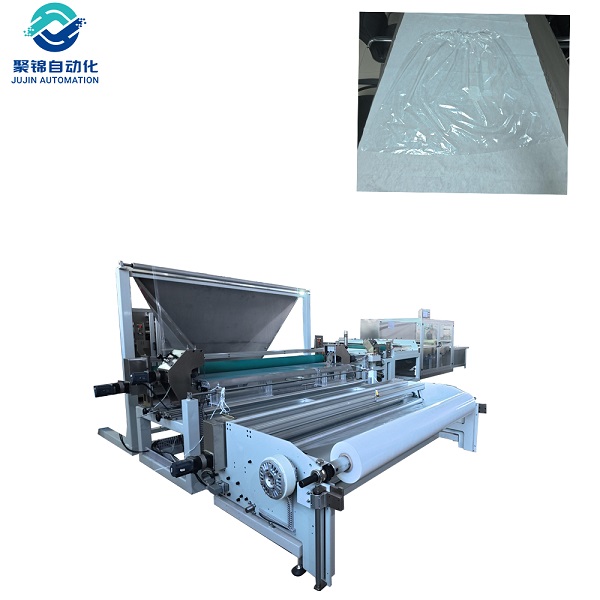
How the Full Production Process Works — Step by Step
Understanding the machine starts with understanding the workflow. In a typical automatic bag making machine, the process follows this sequential path:
PE Film Feeding: A large roll of PE film (roll diameter up to 600 mm for standard machines) is mounted on the material rack and fed into the machine at a controlled, consistent rate.
Film Traction: Motorized traction rollers grip the film and pull it forward with precision. Speed is synchronized with the sealing and cutting cycle to ensure uniform bag lengths.
Horizontal Sealing & Welding: Heated elements — typically aluminum blade (knife) welding bars — press down onto the film at set intervals, creating the bottom seal of the bag. The aluminum blade design ensures a strong, leak-proof bond even on thick PE films.
Cutting: A cutting knife, synchronized with the sealing head, separates individual bags from the continuous film web, either simultaneously with or immediately after sealing.
Folding (for large-format machines): For oversized bags, the finished product is folded multiple times — first via a triangular bucket fold, then a W-longitudinal fold, and finally a series of transverse folds — reducing a 3-meter bag into a compact, manageable square.
Output & Stacking: Finished bags are delivered to a conveyor or collection system for counting, stacking, and downstream packaging.
This entire sequence can repeat at speeds of up to 80 meters per minute, producing hundreds of bags per hour without interruption.
The 6 Main Components of a PE Bag Making Machine
Each component in an automatic bag making machine has a specific, critical role. A failure or misalignment in any single part can affect the quality of every bag produced. Here is a breakdown of what each part does:
1. Material Rack (Film Unwinding Unit)
This is where the raw PE film roll is loaded. The material rack supports the roll and controls the angle and tension at which the film enters the machine. On large-format models, the rack is built to handle roll widths of up to 900 mm and diameters up to 600 mm. Mismanaged unwinding leads to film wrinkles, uneven seals, and wasted material.
2. Automatic Tension Control System
One of the most important — and most underappreciated — components of any PE bag making machine is the tension control system. Because PE film is elastic and stretches under load, maintaining a perfectly consistent, low-tension feed is essential for producing bags with accurate, repeatable dimensions. Advanced machines use automatic cylinder-driven tension control, which continuously adjusts the feed force without any operator input. This is particularly critical for large, lightweight films that would otherwise sag, bunch, or tear during high-speed runs.
3. Traction & Feed Rollers
Servo-motor-driven traction rollers are the heartbeat of the machine. They determine how far the film advances per cycle, which directly controls the finished bag's length. Modern automatic bag making machines use multi-axis servo control to synchronize traction speed with sealing and cutting cycles to within a fraction of a millimeter.
4. Heat-Sealing Unit (Aluminum Blade Welding System)
The heat-sealing unit is responsible for creating the welded seam that forms the base of each bag. In heavy-duty PE bag production, aluminum blade electrothermal welding is the industry standard. A precision-machined aluminum knife heats to a set temperature and presses against the film, melting and fusing the two layers of PE into a single, strong, leak-proof seal. The aluminum material allows for faster heat transfer and more consistent temperature distribution than traditional steel bars, resulting in cleaner, stronger seams at high speed. For those researching sealing science, this resource on PE film sealing properties and thermal behavior offers useful context.
5. Cutting Mechanism
Immediately after sealing, the cutting knife separates the sealed bag from the rest of the film web. The knife must be perfectly synchronized with the sealing head — too early and the seal tears; too late and the bags fuse together. On modern machines, cutting parameters are set digitally through the control panel and are automatically recalculated when the operator changes the target bag length.
6. Multi-Stage Folding System (Large-Format Machines)
Standard small-bag machines simply stack the finished bags on an output conveyor. Large-format PE bag making machines, however, must fold a product that can be over 3 meters long into a package small enough to ship and sell. This is accomplished through a sequenced, automated folding architecture:
Triangular bucket fold: The bag is initially gathered from the sides and folded into a triangular cross-section, dramatically reducing its width.
W-longitudinal fold: The bag is then folded lengthwise using guide plates, halving the length.
4-time transverse fold: A series of four crosswise folds progressively compacts the bag into a small, dense square suitable for retail packaging or export cartons.
7. Touchscreen PLC Control Panel
The brain of the entire operation. A modern automatic bag making machine is operated entirely through a touchscreen human-machine interface (HMI). Operators input the desired bag length, sealing temperature, cutting timing, and folding parameters directly on screen. The PLC (Programmable Logic Controller) then coordinates all servo motors, heating elements, and pneumatic cylinders accordingly. Changing from one bag size to another takes minutes, not hours, with no mechanical retooling required.
Component Summary Table
| Component | Primary Function | Key Feature on Modern Machines |
|---|---|---|
| Material Rack | Supports & unwinds PE film roll | Handles rolls up to 600 mm dia., 900 mm width |
| Tension Control System | Maintains consistent film feed tension | Automatic cylinder-driven, no manual adjustment |
| Traction & Feed Rollers | Controls film advance speed & length | Multi-axis servo motor synchronization |
| Heat-Sealing Unit | Welds bag bottom seam | Aluminum blade electrothermal welding |
| Cutting Mechanism | Separates individual bags from film web | Digital sync with sealing cycle via PLC |
| Folding System | Compacts large bags for distribution | Triangular + W-longitudinal + 4x transverse fold |
| Touchscreen PLC Panel | Central machine control & programming | Full digital input, no mechanical retooling needed |
Types of PE Bag Making Machines and Their Applications
Not every PE bag making machine is designed for the same job. The industry broadly divides these machines into two major categories based on output format size:
Standard-Format Bag Making Machines
These handle everyday PE bags — bread bags, produce bags, refuse sacks, and small retail bags. They typically produce bags up to 600–800 mm in length and run at higher cycle speeds (measured in bags per minute rather than meters per minute) because each individual bag is light and small. Applications span food packaging, retail, healthcare, and consumer goods.
Large-Format / Heavy-Duty PE Bag Making Machines
Designed for oversized protective packaging applications, these machines produce bags ranging from 800 mm to 3,200 mm in length and up to 2,300 mm in width. Primary application areas include:
Furniture & Bedding: Mattress bags, sofa covers, large furniture dust shields — typically one of the highest-volume applications for large-format machines globally.
Industrial Logistics: Pallet covers, shipping container liners, moisture-barrier shrink hoods for export cargo.
Automotive & Aerospace: Protective dust bags for vehicle chassis, engine components, and large structural parts during transit or long-term storage.
Construction & Agriculture: Protective sheeting bags for building materials, soil covers, and agricultural mulch bag applications.
Key Technical Specifications to Evaluate When Buying
When evaluating any automatic bag making machine, buyers should review the following core parameters to ensure the equipment matches their production needs:
| Specification | What to Look For | Typical Range (Large-Format) |
|---|---|---|
| Production Speed | Higher m/min = more output per shift | Up to 80 m/min |
| Finished Bag Length Range | Must cover your target bag size | 800–3,200 mm |
| Finished Bag Width Range | Must cover your target bag width | 1,000–2,300 mm |
| Sealing Method | Aluminum blade preferred for heavy PE | Aluminum knife electrothermal welding |
| Power Supply | Check factory voltage compatibility | 380V / 50Hz typical |
| Total Power Draw | Factor into operating cost calculations | ~7.75 kW (operating power varies by job) |
| Machine Footprint | Ensure factory floor space is sufficient | ~8,170 × 4,270 × 2,800 mm (L×W×H) |
| Control System | Touchscreen PLC preferred for easy changeover | Full touchscreen HMI with digital input |
| Raw Material Roll Diameter | Larger roll = fewer changeovers per shift | ≤600 mm roll diameter |
Why the Sealing Method Matters More Than Most Buyers Realize
The seal is the most structurally critical part of any PE bag. A poor seal means a leaking bag — and for industries like furniture transport or industrial logistics, that translates directly into product damage claims. There are two dominant sealing technologies in the market:
Aluminum Blade (Knife) Electrothermal Welding: The preferred method for heavy PE and large-format bags. The aluminum knife distributes heat evenly across the full seal width, creating a thick, consistent weld that resists peeling even under load. It is also faster to reach operating temperature and easier to clean than alternative systems.
Resistance Wire / Nichrome Wire Sealing: More common on lighter-duty machines producing thin-film bags. Lower initial cost but more prone to hot-spots, uneven sealing on thick films, and shorter element lifespan in continuous-production environments.
For industrial-grade PE bag production — particularly mattress bags, furniture covers, and pallet wraps — aluminum blade welding is the technically superior and commercially preferred choice.
The Role of Automation in Modern PE Bag Production
The shift from semi-automatic to fully automatic bag making machines has transformed the economics of PE bag manufacturing. In a manual or semi-automatic operation, operators must physically adjust mechanical settings when changing bag sizes, monitor tension by feel, and intervene whenever a jam occurs. In a modern fully automatic system:
Size changeovers are completed by inputting new parameters on the touchscreen — no wrenches, no downtime.
Tension is managed by the machine's own cylinder-driven control system, eliminating stretch and wrinkle defects without operator skill dependency.
Production data — speed, cycle count, fault logs — is captured digitally and accessible for quality and efficiency review.
The folding sequence for large bags executes automatically with no manual handling between the cutting and the finished output.
This level of automation means a single operator can oversee a high-speed production line that would previously have required three or four people, fundamentally changing the labor cost model for PE bag manufacturers worldwide.
Need a Reliable PE Bag Making Machine for Your Production Line?
JUJIN manufactures high-speed, large-format automatic bag making machines with aluminum blade welding, full servo control, and smart auto-folding — built for mattress bags, industrial covers, and heavy-duty PE packaging. Factory-direct pricing, 12-month warranty, and worldwide delivery.
Get a Free Quote from JUJINHow to Choose the Right Automatic Bag Making Machine for Your Business
With dozens of machine configurations available, selecting the right PE bag making machine comes down to answering five core questions before approaching any supplier:
What is the largest bag size you need to produce? — This determines whether a standard-format or large-format machine is required. If any dimension of your target bag exceeds 800 mm in length, a large-format machine is the right category.
What daily output volume do you need? — This maps to the required production speed in m/min. Multiply bags per shift by average bag length, then add a 20–30% buffer for changeovers and maintenance windows.
What PE film thickness will you be running? — Heavier-gauge films require more robust tension systems and higher-capacity sealing units. Specify your film weight range to any supplier before requesting a quote.
How frequently will you change bag sizes? — If product variety is high, a touchscreen PLC system with digital size entry is critical. It reduces changeover time from hours to minutes.
What is your factory's power supply configuration? — Most industrial PE bag making machines operate on 380V/50Hz three-phase power. Verify your facility's supply before purchasing.
Summary: What Makes a Great PE Bag Making Machine
A high-performing PE bag making machine is not just about speed — it is the combination of a stable tension system, a reliable heat-sealing method, precise servo-controlled traction, intelligent folding architecture, and an intuitive digital control interface that together determine real-world production efficiency and bag quality. The best automatic bag making machines on the market eliminate operator guesswork and translate directly into lower defect rates, faster changeovers, and higher output per labor hour.
For manufacturers producing large-format PE bags — mattress covers, industrial protective bags, pallet wraps — the engineering demands are even higher: the machine must handle massive film formats at speed without wrinkling, stretching, or misaligning, then fold the output into compact, shippable squares automatically.
If sourcing a dependable machine for this kind of production is the goal, JUJIN — based in Changzhou, Jiangsu Province, China — is a specialized factory-direct manufacturer of high-speed large-format PE bag making equipment, with machines capable of producing bags up to 3,200 mm × 2,300 mm at 80 m/min. Exploring their equipment lineup is a logical starting point for any serious buyer.
Ready to explore the right machine for your production line?
View JUJIN's Large-Format PE Bag Equipment →


