


The global demand for disposable hygiene products continues to rise, driven by growing tourism, healthcare infrastructure expansion, and increased public awareness of personal hygiene. Among these products, disposable toilet seat covers occupy a unique niche—they are low-cost, high-volume consumables used in hotels, hospitals, airports, shopping malls, and public restrooms worldwide. For manufacturers and entrepreneurs looking to enter this market, one of the first and most important decisions is choosing between a non-woven toilet seat cover making machine and a PE film toilet seat cover making machine.
These two technologies produce products that look similar on the surface but differ significantly in material properties, production process, cost structure, and target market. Selecting the wrong machine can lead to wasted investment, unsold inventory, and missed market opportunities. This guide provides a comprehensive, side-by-side comparison of both machine types, covering material science, equipment design, production economics, product performance, and market positioning. By the end, readers should have a clear framework for deciding which toilet seat cover making machine aligns with their business goals.
Key Takeaways
Material defines the product. Non-woven covers feel like soft cloth and breathe; PE film covers are fully waterproof and cost less per unit.
PE film = higher speed, lower cost. PE film toilet seat cover making machines generally run faster and use cheaper raw material, favoring high-volume markets.
Non-woven = premium positioning. Non-woven toilet seat cover making machines produce a higher-perceived-value product favored by hotels and hospitals.
Machines are not interchangeable. Bonding and cutting mechanisms differ fundamentally—ultrasonic/thermal for non-woven, heat sealing for PE film.
Market research first, equipment second. The right choice depends on which customer segment and price point the business plans to serve.
Understanding the Materials: Non-Woven Fabric vs. PE Film
Before comparing the machines themselves, it is essential to understand the raw materials each one processes. The material determines not only the feel and performance of the finished product but also the entire manufacturing process, from unwinding and feeding to cutting, bonding, and folding.
Non-Woven Fabric
Non-woven fabric is a sheet-like material made from staple or continuous fibers bonded together by chemical, mechanical, heat, or solvent treatment—without weaving or knitting [source]. For toilet seat covers, the most common non-woven material is spunbond polypropylene (PP), typically in the 20–50 g/m² weight range. Spunbond non-woven is produced in a continuous process where fibers are spun and directly dispersed into a web, then bonded thermally or by resin. This creates a fabric that is soft, breathable, lightweight, and has a cloth-like texture.
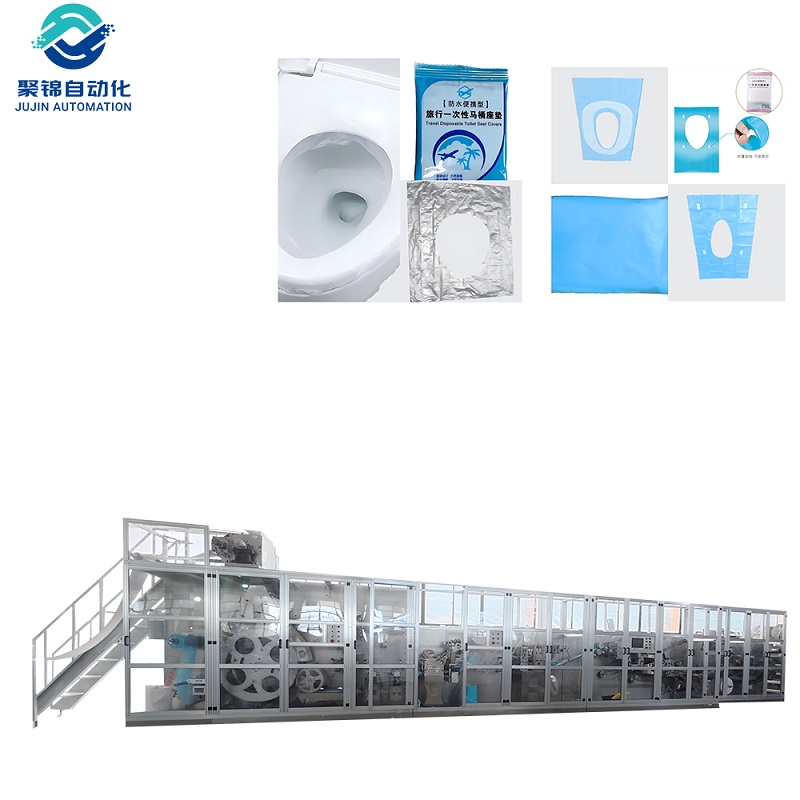
Key properties of non-woven toilet seat cover material:
Soft, cloth-like feel: More comfortable against skin than plastic film.
Breathable: Allows air circulation, reducing sweat and discomfort.
Absorbent surface: Can absorb small amounts of moisture, though most products have a water-resistant coating or PE film backing.
Tear-resistant: Fiber structure provides good tensile strength in both directions.
Recyclable: Polypropylene non-woven can be recycled with other PP plastics.
PE Film (Polyethylene Film)
PE film, or polyethylene film, is a thin, flexible plastic sheet produced by blown film or cast film extrusion. Low-density polyethylene (LDPE) is the most common grade used for disposable toilet seat covers, with a typical thickness of 0.015–0.04 mm (15–40 microns). LDPE has a density range of 0.910–0.940 g/cm³ and is known for its flexibility, clarity, and excellent moisture barrier properties [source].
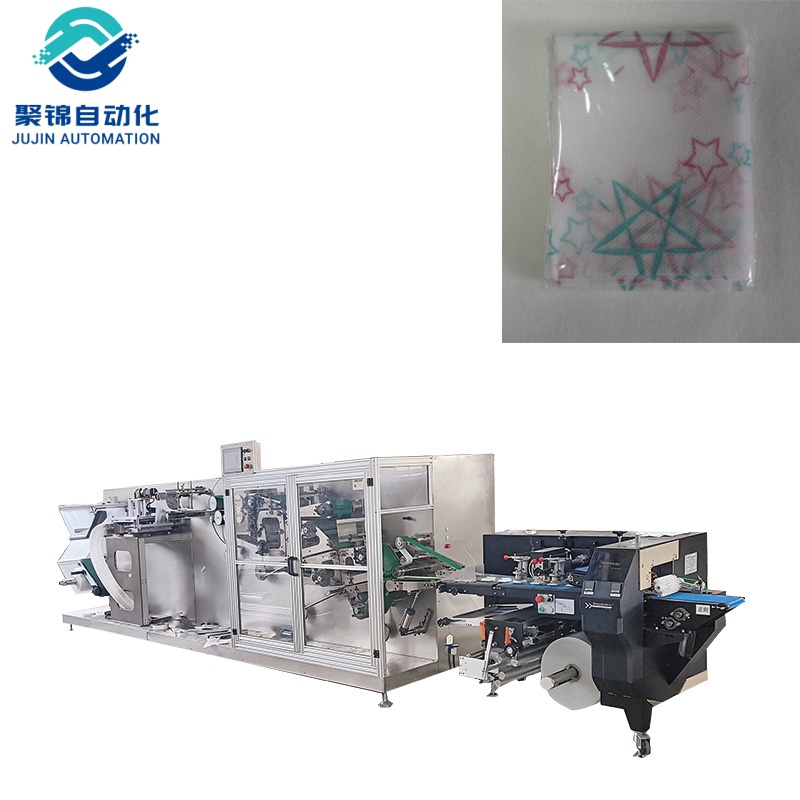
Key properties of PE film toilet seat cover material:
100% waterproof: Creates an impermeable barrier between the user and the toilet seat.
Low cost per unit: PE film is generally cheaper than non-woven fabric per square meter.
Lightweight: Thin film means low shipping and storage costs.
Smooth, glossy surface: Easy to print on for branding or instructions.
Heat-sealable: Can be easily bonded and cut with heated tools.
How Each Toilet Seat Cover Making Machine Works
While both machine types follow the same general workflow—material feeding, forming/cutting, folding, and optional packaging—the specific mechanisms at each stage differ significantly due to the properties of the raw material.
Non-Woven Toilet Seat Cover Making Machine
A non-woven toilet seat cover making machine is designed to handle the fibrous, somewhat stretchy nature of non-woven fabric. The typical production line includes the following stations:
Unwinding station: One or more rolls of non-woven fabric (and optionally a PE film backing layer) are mounted on unwind shafts with tension control to prevent stretching or wrinkling.
Printing station (optional): Flexographic or gravure printing can add patterns, logos, or usage instructions directly on the material.
Bonding station: If the product uses a multi-layer structure, layers are laminated using thermal bonding or ultrasonic welding. Ultrasonic bonding creates a strong, localized bond without melting the entire fiber structure.
Cutting and forming station: A rotary die cutter or ultrasonic cutter shapes the material into the toilet seat cover profile, including the central oval cutout. Sharp precision tooling prevents fiber fraying.
Adhesive application (optional): Some premium products apply adhesive strips to the four corners to keep the cover in place. This requires a precise hot-melt glue system.
Folding station: Multi-fold mechanisms fold the cover into a compact, dispenser-ready size (typically 1/8 or 1/16 fold).
Packaging station (optional): Individual wrapping or bulk counting into dispenser packs.
Non-woven machines tend to be longer and more complex because the fibrous material requires careful tension management and more sophisticated bonding. High-end models often feature aluminum alloy frames with transparent safety enclosures and PLC touchscreen control.
PE Film Toilet Seat Cover Making Machine
A PE film toilet seat cover making machine processes a smooth, uniform plastic film that is easier to handle than non-woven but requires precise temperature control for heat sealing. The typical workflow includes:
Unwinding station: A roll of PE film (often pre-printed) is fed into the machine. Vacuum belts or pin rollers maintain accurate positioning.
Corona treatment (optional): A surface treatment that improves ink adhesion if printing is done inline.
Heat sealing station: Heated sealing bars or rotary heat sealers bond layers of film together. Temperature, pressure, and dwell time must be precisely controlled.
Cutting station: A heated knife or die cutter trims the outline and cuts the central hole. Heat cutting simultaneously seals the edges.
Folding station: Multi-fold mechanisms create compact folds.
Individual packaging station: Many PE film products are individually wrapped in small sachets for travel and retail sale, often integrated directly into the line.
PE film machines are generally more compact and have fewer stations because the material does not require ultrasonic bonding or multi-layer lamination. The heat-seal-and-cut process is efficient and well-suited to high-speed continuous production. Many PE film toilet seat cover making machines include an integrated individual wrapping unit, ideal for travel-sized retail packs.
Side-by-Side Comparison: Non-Woven vs. PE Film Machine
The following table summarizes the key differences across dimensions that matter most to equipment buyers and production managers.
| Dimension | Non-Woven Machine | PE Film Machine |
|---|---|---|
| Raw material | Spunbond PP non-woven, 20–50 g/m² | LDPE film, 15–40 microns |
| Bonding method | Ultrasonic welding / thermal bonding | Heat sealing |
| Cutting method | Rotary die / ultrasonic cutting | Heated knife / die cutting |
| Typical speed | 60–150 pieces/min | 100–200 pieces/min |
| Material cost per unit | Higher | Lower |
| Machine footprint | Larger (more stations) | More compact |
| Product feel | Soft, cloth-like, breathable | Smooth, plastic, waterproof |
| Waterproof barrier | Moderate (may need PE backing) | Excellent (impermeable) |
| Typical market | Hotels, hospitals, airlines | Travel retail, budget hotels, malls |
| Selling price | Higher (premium) | Lower (value) |
| Individual packaging | Optional | Commonly integrated |
| Environmental profile | Recyclable PP; some biodegradable | Recyclable PE; less material by weight |
Production Economics: Cost, Speed, and Margin
For most buyers, the financial performance of the toilet seat cover making machine is the deciding factor. Understanding the cost structure of each product type helps estimate break-even points and potential profitability.
Raw Material Cost
PE film is generally the cheaper raw material. A 20-micron LDPE film weighs approximately 18–20 g/m², while a typical 30 g/m² non-woven fabric is heavier and more expensive per square meter. However, non-woven covers can sometimes be produced without an additional waterproof layer if full impermeability is not required, offsetting some cost difference. Buyers should obtain current material quotes from regional suppliers, as prices fluctuate with oil prices and polymer markets.
Production Speed and Labor
PE film toilet seat cover making machines typically operate at higher speeds (100–200 pieces per minute) compared to non-woven machines (60–150 pieces per minute). The simpler material handling and heat-seal process allow faster continuous operation. Both types are increasingly automated with PLC control, automatic tension adjustment, and fault detection, meaning one operator can manage an entire line. The higher throughput of PE film machines spreads fixed labor costs over more units.
Equipment Investment
As a general range, basic semi-automatic toilet seat cover making machines start at approximately $15,000–$25,000. Fully automatic non-woven lines with ultrasonic bonding and folding can range from $50,000 to over $100,000. PE film automatic lines with integrated individual packaging typically fall in the $40,000–$80,000 range. These are rough estimates—final pricing depends on configuration, speed, automation level, and optional features. Buyers should request detailed quotations based on specific product specifications.
Margin Profile
PE film products typically have lower per-unit revenue but also lower costs, resulting in moderate margins on high volume. Non-woven products command higher selling prices due to perceived quality and comfort, offering potentially higher margins per unit but at lower volume. The optimal choice depends on whether the strategy prioritizes high-volume low-margin throughput or lower-volume higher-margin premium positioning.
Product Performance and User Experience
The end-user experience differs noticeably between the two product types, and this directly influences which customers will buy which product.
Comfort and Feel
Non-woven covers are generally considered more comfortable. The fibrous texture resembles cloth, does not stick to skin, and allows some air circulation. PE film covers, while fully waterproof, can feel cold and slightly sticky against the skin, especially in warm environments. This comfort difference is why upscale hotels and healthcare facilities often prefer non-woven products.
Hygiene and Barrier Protection
From a strict barrier perspective, PE film provides superior protection because it is completely impermeable to moisture and microorganisms. Non-woven fabric alone is porous and may allow moisture to pass through; many non-woven toilet seat covers therefore include a thin PE film backing layer to achieve waterproof performance. This multi-layer construction adds cost but combines comfort with barrier protection.
Dispensing and Convenience
Both product types fit standard toilet seat cover dispensers. Non-woven covers tend to hold their folded shape better and dispense more reliably from wall-mounted dispensers. PE film covers can stick together due to static electricity, potentially causing double-dispensing or jams, though anti-static additives in the film formulation can mitigate this.
How to Choose: A Decision Framework
There is no universally "better" machine—the right choice depends on the specific business context. The following framework helps match equipment to market conditions.
Choose a Non-Woven Toilet Seat Cover Making Machine If:
The target market includes hotels, hospitals, airlines, corporate offices, or premium restrooms where comfort and perceived quality drive purchasing.
The business can sell at a premium price point and prioritize margin per unit over sheer volume.
Customers value eco-friendliness, as non-woven PP is recyclable and some biodegradable options exist.
The product will be dispensed from wall-mounted dispensers in institutional settings.
The buyer has sufficient capital for a higher initial equipment investment.
Choose a PE Film Toilet Seat Cover Making Machine If:
The target market is price-sensitive—budget hotels, shopping malls, gas stations, public restrooms, and retail travel packs.
The business strategy focuses on high-volume production with fast turnaround and low per-unit cost.
Individual retail packaging (travel-sized sachets) is a key product format.
Maximum waterproof barrier protection is the primary selling point.
The buyer wants a more compact machine with lower initial investment and faster ROI.
Consider Both for Diversified Production
Some larger manufacturers operate both machine types to serve multiple market segments simultaneously. This requires more capital and floor space but provides revenue diversification. For new entrants, it is generally advisable to start with one machine type, establish a customer base, and expand only after the first line is running profitably.
Key Features to Look for in Any Toilet Seat Cover Making Machine
Regardless of which toilet seat cover making machine type is chosen, certain features contribute to reliable production, low downtime, and consistent quality. Buyers should evaluate the following when comparing any toilet seat cover making machine:
PLC touchscreen control: Easy adjustment of speed, temperature, cutting length, with recipe storage for different products.
Automatic tension control: Prevents stretching, wrinkling, and misalignment during high-speed operation.
Photoelectric sensor tracking: Ensures accurate cutting registration, especially for pre-printed materials.
Safety enclosures: Transparent guards with interlock switches protect operators from moving parts and heated components.
Automatic fault detection: Minimizes waste by stopping when material runs out, seals fail, or jams occur.
Stainless steel or aluminum construction: Resists corrosion and meets hygiene standards.
After-sales support: Spare parts availability, technical documentation, and manufacturer responsiveness are critical.
Ready to Invest in a Toilet Seat Cover Making Machine?
JUJIN manufactures both non-woven and PE film toilet seat cover making machines with full automation, PLC control, and optional individual packaging. Get a customized quotation based on your target product, speed, and budget.
Request a Free Quote →Factory direct pricing · Custom configuration · Global shipping · Installation support available
Conclusion
The choice between a non-woven toilet seat cover making machine and a PE film toilet seat cover making machine ultimately comes down to market positioning and production strategy. Non-woven machines produce a premium, cloth-like product that commands higher prices and appeals to quality-conscious buyers in hospitality and healthcare. PE film machines deliver a waterproof, low-cost product at higher speeds, ideal for high-volume, price-sensitive markets and retail travel packs.
Neither technology is inherently superior—each excels in its intended segment. The most successful manufacturers carefully research target customers, understand the local competitive landscape, and select equipment matching their production capacity and margin goals. Working with an experienced toilet seat cover making machine manufacturer that provides technical consultation, sample production, and after-sales support significantly reduces investment risk and shortens the path to profitable operation.
For businesses still uncertain about which toilet seat cover making machine direction to take, many manufacturers offer sample products and pilot production runs allowing buyers to test market acceptance before committing to a full line. This low-risk approach provides valuable real-world data on customer preference, pricing elasticity, and distribution channel fit.
Frequently Asked Questions
Q: What is the difference between non-woven and PE film toilet seat covers?
A: Non-woven covers are made from bonded polypropylene fibers, offering a soft, cloth-like feel and breathability. PE film covers are made from polyethylene plastic film, providing complete waterproof barrier protection at a lower material cost. Both are disposable but target different market segments.
Q: Which toilet seat cover making machine is more profitable?
A: PE film machines generally have lower material costs and higher production speeds, offering better margins for high-volume, price-sensitive markets. Non-woven machines produce a premium product with higher per-unit selling price, targeting hospitality and healthcare where comfort and perceived quality matter more.
Q: Can one machine produce both non-woven and PE film toilet seat covers?
A: Generally no. The two materials require different feeding, cutting, and sealing mechanisms. Non-woven machines use ultrasonic or thermal bonding, while PE film machines use heat sealing. Most buyers choose a dedicated line for consistent quality and speed.
Q: What is the typical production speed of a toilet seat cover making machine?
A: Automatic PE film machines typically produce 100–200 pieces per minute. Non-woven machines range from 60–150 pieces per minute depending on complexity. Actual speed depends on product size, folding complexity, and whether individual wrapping is included.
Q: How much does a toilet seat cover making machine cost?
A: Basic semi-automatic models start around $15,000–$25,000, while fully automatic lines with individual packaging range from $40,000 to over $100,000. Non-woven machines with multi-layer bonding tend to be at the higher end. Final pricing depends on configuration and features.
Q: Which material is more environmentally friendly?
A: Non-woven polypropylene is technically recyclable and can be incinerated with lower toxic emissions than PE film. However, both are single-use plastics. Some manufacturers offer biodegradable non-woven options. PE film uses less material by weight for the same coverage area.
Q: Do I need individual packaging for my toilet seat covers?
A: It depends on the distribution channel. Wall-mounted dispensers use bulk-packed covers. Retail travel packs and hotel guest amenities require individual wrapping. Many PE film machines integrate a packaging unit, while non-woven lines may offer it as an optional add-on.
Q: What is the minimum order quantity for custom production?
A: This varies by manufacturer and product type. PE film travel packs often have lower MOQs due to faster production. Non-woven institutional packs may require larger runs. Buyers should discuss MOQ requirements directly with manufacturers during quotation.


