


The Ultimate Guide to Buying a Toilet Seat Cover Making Machine
Disposable toilet seat covers have become a standard part of public restroom hygiene — found in hotels, airports, hospitals, trains, and event venues around the world. Behind every stack of pocket-sized covers sits a production machine that shapes, seals, and folds them at high speed. This guide explains what a toilet seat cover making machine does, how it works, which specifications matter, and how to buy one that matches a real production plan.
Key Takeaways
A toilet seat cover making machine is a converting system that turns rolls of nonwoven fabric — often laminated with a waterproof film — into finished, folded, single-use toilet seat covers.
Most covers use a soft nonwoven top layer combined with a polyethylene (PE) film bottom layer, so the finished cover is comfortable against the skin and waterproof.
Modern machines seal the covers with ultrasonic welding instead of glue, producing soft, leak-proof edges at production speeds of up to about 100 pieces per minute.
Folding is built into the machine: longitudinal folds plus three transverse folds turn a long cover into a compact, pocket-sized square ready for dispensing.
Capacity, material widths, sealing method, and the ability to connect to a packaging line should all be checked before purchase.
Buying directly from an experienced manufacturer usually means better control over price, spare parts, and after-sales support.
What Is a Toilet Seat Cover Making Machine?
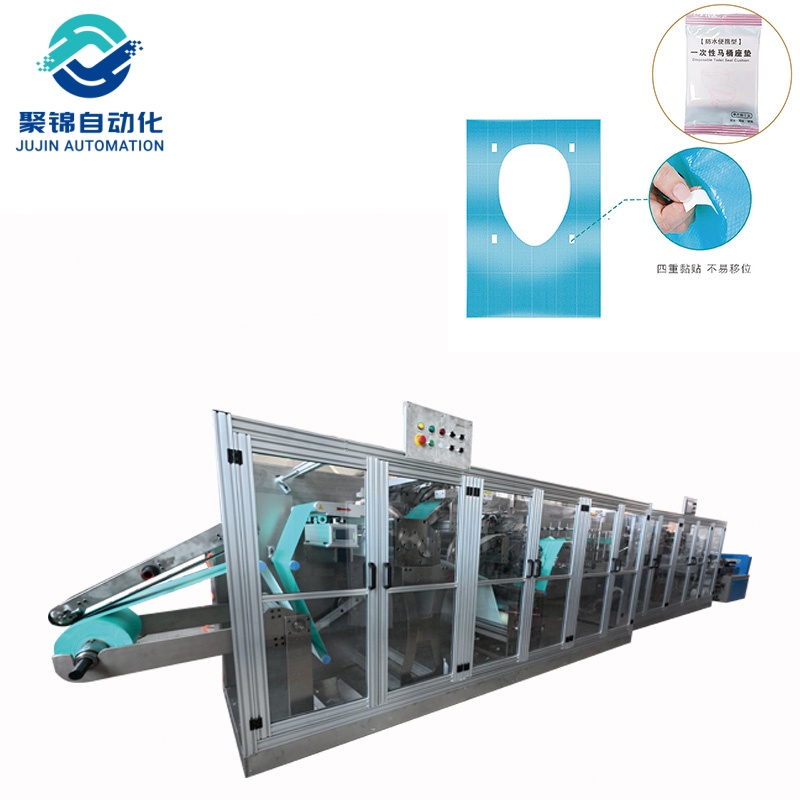
A toilet seat cover machine is industrial converting equipment that takes rolls of nonwoven fabric — and in many models a roll of PE film as well — and automatically turns them into finished disposable toilet seat covers. The machine feeds the material, shapes each cover, seals its edges, cuts it free, folds it into a compact square, and delivers a counted stack, ready for manual or automated packaging.
The process is fully automatic between roll changes: no manual cutting, gluing, or folding is needed. That is why one machine can replace a whole line of manual work, and why output is usually measured in pieces per minute rather than pieces per hour. Buyers meet two main design families: machines that build a waterproof dual-layer cover, and machines that add adhesive tabs so the cover stays fixed on the seat.
Why Nonwoven Fabric Is the Standard Material
Understanding the material explains what the machine has to handle. A nonwoven is an engineered sheet of fibers bonded together by physical or chemical means — not woven or knitted like normal fabric. Industry associations describe how these engineered materials are made and used across hygiene products, and the international standard defining nonwoven materials sets the common terminology. Two nonwovens industry associations and the nonwovens industry information resources publish detailed background on how these fabrics are produced and where they are used.
| Material | Typical Weight | Role in the Toilet Seat Cover |
|---|---|---|
| PP spunbond nonwoven (top layer) | Roughly 20–40 g/m² | Soft, skin-friendly, breathable surface that contacts the user |
| PE film (bottom layer) | Thin film | Waterproof barrier that stops moisture reaching the seat or clothing |
| Paper (alternative) | Light tissue grades | Economical option for covers without a waterproof layer |
Weights are typical reference ranges; the exact specification depends on the final product and market.
Two-layer covers are the most common premium configuration: the soft nonwoven surface sits against the skin, while the film layer underneath blocks fluids. The machine must therefore handle two rolls at once and keep both at the same tension, because a wrinkled film or a stretched web produces defective covers at speed.
How the Machine Works, Step by Step
In a typical dual-layer machine, the process follows a fixed sequence. Every stage is synchronized by the control system, so the material moves through without stopping:
Unwinding: rolls of nonwoven fabric and PE film are mounted and fed into the machine under automatic tension control.
Edge sealing: ultrasonic sealing units bond the edges of both layers so the cover does not fray or leak.
Lamination: the nonwoven and film layers are bonded together over the full width of the web.
Embossing and forming: the composite web is embossed and formed into the shape of a toilet seat cover.
Cutting: each individual cover is cut free from the continuous web, with the cut edges already sealed.
Folding: a synchronized folding unit makes longitudinal folds followed by three transverse folds, producing a compact square.
Output and counting: finished covers are delivered, counted, and stacked, ready to be connected to a packaging machine.
The same principle applies to glued covers, with one extra station: adhesive tabs are applied so the cover can be fixed to the seat. Whatever the design, the entire run is monitored by the operator through a touchscreen, and switching product sizes is done by entering new parameters rather than changing mechanical parts.
Main Components of a Toilet Seat Cover Machine
Each component has a specific job, and a misalignment in any one of them shows up in every cover produced during that run.
| Component | Function | What to Check |
|---|---|---|
| Unwinding and tension system | Feeds nonwoven and film rolls at constant tension | Automatic cylinder-driven control; handles roll widths up to the machine rating |
| Ultrasonic sealing unit | Bonds edges and layers without glue | Generator quality, uniform sealing, soft edges |
| Forming and die-cutting unit | Shapes and cuts each cover | Cut accuracy, sealed cut edges, no loose fibers |
| Folding module | Folds the cover into a compact square | Longitudinal plus three transverse folds, synchronized timing |
| Glue tab unit (optional) | Applies adhesive tabs to glued covers | Adhesive application accuracy, release paper handling |
| Control panel | Coordinates speed, temperature, and folding | Touchscreen operation, easy size changeover, alarms |
Ultrasonic Sealing vs. Glued Covers
Two production approaches dominate the market, and the choice changes both the machine and the final product.
| Factor | Ultrasonic Dual-Layer Covers | Glued Covers |
|---|---|---|
| Construction | Nonwoven laminated to a waterproof film | Nonwoven cover with adhesive tabs |
| Edge sealing | Ultrasonic welding — no glue, soft edges | Sealed edges, plus glue on the tabs |
| Waterproofing | Yes, thanks to the film layer | Depends on the material used |
| How it stays on the seat | Shape and material hold it in place | Adhesive tabs fix it to the seat |
| Typical use | Premium hygiene covers for travel and medical settings | General-purpose covers for public restrooms |
Ultrasonic welding is increasingly preferred for premium covers because it creates a strong, leak-proof seam without the hard edges that thermal glue can leave, and the seam remains soft against the skin. Glued covers, by contrast, solve a different problem — keeping the cover securely positioned on the seat — so the two types are best seen as complements rather than competitors.
Key Technical Specifications to Evaluate
When comparing machines, the specifications below decide whether the equipment matches the production plan.
| Specification | What to Look For | Typical Range / Note |
|---|---|---|
| Production speed | Sustained output, not just peak speed | Commonly 80–100 pieces per minute on high-speed lines |
| Material width | Roll width the machine can handle | 800 mm is a common rating; check roll diameter limits |
| Layers processed | Nonwoven only, or nonwoven plus film | Dual-layer models produce waterproof covers |
| Sealing method | Ultrasonic or glue application | Ultrasonic for soft, waterproof seams |
| Folding configuration | Folds per cover | Longitudinal plus three transverse folds is typical |
| Power supply | Matches factory voltage | For example 380V / 50Hz on industrial lines |
| Packaging interface | Can it dock with a packaging machine | Conveying outlet designed for flow-wrapping lines |
Values are typical industry ranges; confirm exact figures with the manufacturer for a specific model.
Common Quality Problems and How to Avoid Them
| Problem | Common Cause | What to Do |
|---|---|---|
| Wrinkled film at speed | Uneven tension between the two rolls | Use automatic tension control and check roll alignment |
| Unsealed or weak edges | Incorrect ultrasonic settings or worn tooling | Check generator settings and seal tool condition |
| Misshapen covers | Feed misalignment or worn cutting die | Realign the web and replace worn dies |
| Inconsistent folding | Folding timing out of sync | Re-synchronize the folding unit with the cutting cycle |
| Glue failures on tabs | Adhesive application or release paper issues | Check adhesive temperature, quantity, and paper tracking |
| Counting errors | Sensor or stacking misalignment | Calibrate sensors and verify stack counting |
Safety, Hygiene, and Maintenance
Guarding: keep all moving parts and sealing units guarded, and train operators before first use.
Hygiene: the machine produces hygiene products, so the work area and the machine surfaces should be kept clean to avoid contaminating the covers.
Routine maintenance: check ultrasonic generators, sealing tools, drive belts, and tension sensors regularly; keep the machine lubricated according to the manual.
Spare parts: confirm the availability of commonly worn parts such as sealing horns, cutting dies, and sensors before buying.
Where These Machines Are Used
Disposable toilet seat covers are a high-volume consumable, which is why production is usually centralized on fast machines rather than done in small workshops. Typical buyers include:
Suppliers serving hotels, airports, airlines, and high-speed rail.
Medical and maternity care distributors supplying hospitals and clinics.
Cleaning and hygiene product wholesalers for public restrooms and events.
Private-label brands that package covers under their own names.
Because the product is used once and discarded, the economics depend on speed, material yield, and low waste — all of which are decided by the machine.
How to Buy a Toilet Seat Cover Machine
Buying decisions should start from the production plan, not from a brochure. The questions below cover the points that matter most:
Output target: daily cover volume and the number of working hours set the required speed.
Product type: waterproof dual-layer covers or glued covers — the machine design differs.
Material plan: roll widths and suppliers of nonwoven and film.
Packaging: whether the line will include a packaging machine, and whether the two can dock together.
Facility: available power supply, floor space, and operator skill level.
Support: installation guidance, training videos, warranty terms, and spare parts supply.
Buyers comparing suppliers will meet both dual-layer ultrasonic machines and glued-cover lines. A disposable non-woven toilet seat cover machine produces waterproof ultrasonic-sealed covers at up to 100 pieces per minute, while an automatic glued nonwoven toilet seat cover machine is designed for covers with adhesive tabs. Both should be evaluated against the recipes and volumes the plant actually runs.
Looking for a Reliable Toilet Seat Cover Making Machine Manufacturer?
JUJIN is an original manufacturer of disposable hygiene converting machines. Its dual-layer line feeds nonwoven fabric and PE film together, seals the covers with ultrasonic welding, and produces up to 100 pieces per minute with automatic folding. The machine can dock with downstream packaging equipment, and JUJIN provides installation videos, on-site engineer dispatch on request, and a 12-month mechanical parts warranty. Buyers can contact JUJIN directly for specifications, samples, and quotes.
Send Inquiry — Get a QuoteConclusion
A toilet seat cover making machine is a complete production line in one frame: rolls of nonwoven and film go in, and sealed, folded, counted covers come out. The machine type — ultrasonic dual-layer or glued — should match the product the buyer intends to sell, while speed, material handling, and packaging integration decide the cost per cover. With a clear specification and a reliable manufacturer, it turns a hygiene consumable into a repeatable, profitable product rather than a source of downtime.
Frequently Asked Questions
What does a toilet seat cover machine produce?
It produces single-use toilet seat covers from rolls of nonwoven fabric, and in dual-layer models from nonwoven plus PE film. The machine seals, cuts, and folds each cover into a compact square ready for dispensing.
What material is used to make disposable toilet seat covers?
Most covers use polypropylene spunbond nonwoven, typically around 20–40 g/m², and many add a thin PE film layer for waterproofing. Some economy covers are made of paper.
How fast can a toilet seat cover machine run?
High-speed industrial machines typically run at 80–100 pieces per minute. Actual output depends on cover size, material, and whether the line is connected to a packaging machine.
What is the difference between ultrasonic and glued toilet seat covers?
Ultrasonic covers are sealed by high-frequency welding with no glue, producing soft, waterproof edges. Glued covers use adhesive tabs to hold the cover in place on the seat. The right choice depends on the target product.
Can the machine connect to a packaging line?
Yes. Many machines are designed with a conveying outlet that docks with downstream flow-wrapping or packaging machines, allowing a fully automatic, touch-free production cycle.
Where can buyers find a reliable toilet seat cover machine manufacturer?
Wholesale and industrial buyers usually purchase directly from manufacturers to avoid intermediary markups. It is worth checking the machine against the production plan, asking for specifications and references, and requesting a quote. JUJIN supplies ultrasonic dual-layer and glued-cover machines and accepts inquiries directly.


