


The global healthcare and personal care industries are experiencing sustained growth in demand for disposable hygiene products. Among these, disposable nursing pads—also known as medical underpads or bed pads—have become essential supplies in hospitals, nursing homes, maternity centers, and home care settings. As aging populations expand and healthcare infrastructure develops across emerging markets, the need for efficient, reliable manufacturing equipment has never been more pressing.
For entrepreneurs, factory managers, and investment decision-makers considering entry into this sector, selecting the right nursing pad making machine is a critical choice that directly impacts production capacity, product quality, operating costs, and long-term profitability. This comprehensive guide walks through every essential factor a buyer should evaluate before purchasing a nursing pad making machine, from understanding the technology and technical specifications to assessing regulatory compliance, calculating return on investment, and choosing a trustworthy manufacturer of nursing pad making machines.
Key Takeaways
A disposable nursing pad making machine is an industrial converting line that transforms raw materials—nonwoven fabric, tissue paper, fluff pulp, super absorbent polymer (SAP), and polyethylene (PE) film—into finished, multi-layered absorbent pads through a continuous automated process.
Full-servo machines offer the highest precision (±0.02 mm positioning accuracy), fastest stable speeds, and lowest long-term maintenance costs, making them the preferred choice for serious manufacturers, while mechanical and semi-servo models may suit budget-constrained or lower-volume operations.
Production speed, finished product size range, power consumption, raw material compatibility, sealing technology, and automation level are the six core technical specifications that determine a machine's real-world performance and total cost of ownership.
Regulatory compliance—including FDA Class I classification, ISO 9001 quality management, and CE marking for the European market—is non-negotiable for manufacturers targeting international customers.
Total cost of ownership extends far beyond the purchase price; buyers must account for raw material costs, energy consumption, labor, maintenance, spare parts, and downtime when evaluating the true economics of a nursing pad making machine.
1. Understanding Disposable Nursing Pads and Their Market
Before evaluating manufacturing equipment, it is essential to understand the product itself and the market dynamics that drive demand.
What Is a Disposable Nursing Pad?
A disposable nursing pad is a flat, multi-layered absorbent sheet designed to protect mattresses, beds, or surfaces from bodily fluids such as urine, blood, or other excretions. It is widely used across multiple care scenarios:
Hospital and clinical settings: Surgical procedures, patient bed protection, and post-operative care
Geriatric and long-term care: Incontinence management for elderly residents in nursing homes
Maternity and postpartum care: Labor and delivery rooms, postpartum recovery beds
Pediatric and infant care: Diaper changing areas and crib protection
Pet care: Training pads for dogs and other animals
Home care: Family care for bedridden patients or elderly relatives
Market Size and Growth Outlook
The global disposable nursing pads market has demonstrated consistent growth. According to industry research, the global disposable nursing pads market was valued at approximately USD 1.02 billion in 2025 and is projected to reach USD 1.7 billion by 2034, representing a compound annual growth rate (CAGR) of 5.8% during the forecast period. The broader medical nursing pad segment was estimated at around USD 1.89 billion in 2025, reflecting the significant scale of this category.
Several structural factors underpin this growth:
Global population aging: The United Nations reports that the number of people aged 65 and older is growing faster than all younger age groups, directly increasing demand for incontinence and care products.
Healthcare infrastructure expansion: Emerging markets in Southeast Asia, the Middle East, Africa, and Latin America are rapidly building hospitals and care facilities.
Rising hygiene awareness: Growing middle-class populations increasingly prioritize disposable hygiene products over reusable alternatives.
Post-pandemic healthcare investment: Governments worldwide have increased healthcare spending, including procurement of disposable medical supplies.
For manufacturers, these trends translate into sustained demand and a favorable environment for investing in a high-quality nursing pad making machine that can deliver consistent output at competitive costs.
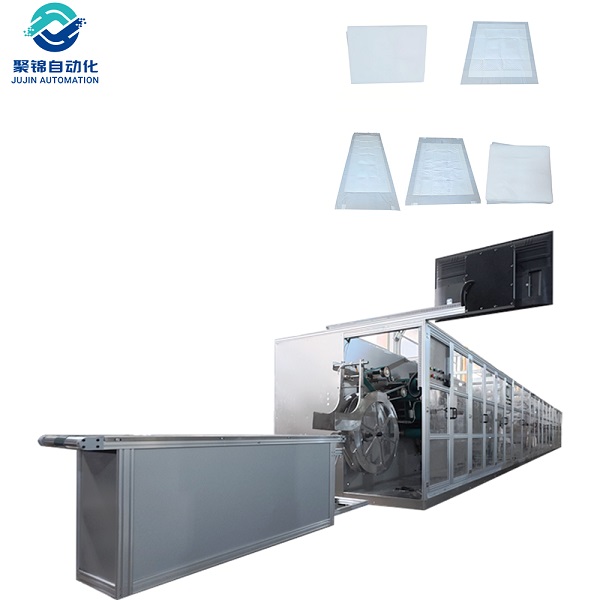
2. How a Nursing Pad Making Machine Works
Understanding the manufacturing process helps buyers evaluate different nursing pad making machine configurations and identify which features matter most for their specific product requirements.
The Five-Layer Product Structure
A standard disposable nursing pad consists of five functional layers, each serving a specific purpose:
| Layer | Material | Function |
|---|---|---|
| Top sheet | Hydrophilic nonwoven fabric (PP spunbond) | Soft, skin-friendly surface that allows fluid to pass through quickly while maintaining a dry feel |
| First absorbent layer | Tissue paper | Distributes fluid evenly across the pad surface |
| Core absorbent layer | Fluff pulp + Super Absorbent Polymer (SAP) | The primary absorption layer; fluff pulp provides rapid fluid uptake, while SAP locks in liquid and prevents rewetting |
| Second absorbent layer | Tissue paper | Wraps and stabilizes the core, preventing pulp migration |
| Bottom sheet | Polyethylene (PE) film | Waterproof barrier that prevents fluid from leaking through to the mattress or surface |
Some premium or specialized products may include additional features such as adhesive strips for securing the pad to bedding, odor-control additives, or antibacterial treatments.
The Manufacturing Process Step by Step
A modern nursing pad making machine executes the following operations in a continuous, synchronized sequence:
Multi-roll unwinding: Raw material rolls—nonwoven fabric, tissue paper, PE film, and fluff pulp—are loaded onto unwinding stations. Advanced machines use independent servo motors with automatic tension control to ensure zero-tension feeding, preventing material stretching or deformation.
Core formation: Fluff pulp is hammer-milled into loose fibers and deposited onto a forming drum or conveyor. SAP particles are simultaneously distributed and mixed with the pulp fibers. The amount of SAP and pulp can be adjusted to control absorption capacity.
Core wrapping: The formed absorbent core is wrapped between two layers of tissue paper, which are bonded using hot-melt adhesive applied in precise patterns.
Lamination and composite bonding: The top nonwoven sheet and bottom PE film are laminated onto the wrapped core. Adhesive is applied to secure all layers together, ensuring the pad maintains its structural integrity during use.
Edge sealing: The longitudinal (lengthwise) and transverse (crosswise) edges are sealed to create a leak-proof perimeter. Two primary technologies are used: adhesive sealing (hot-melt glue applied along edges and pressed under heat) and ultrasonic welding (high-frequency ultrasonic vibrations generate localized heat that fuses layers together, producing cleaner, stronger seals without hard glue lines).
Embossing: A patterned roller creates a quilted or diamond-embossed surface on the pad. Embossing improves fluid distribution, enhances aesthetic appearance, and helps lock the absorbent core in place.
Cutting: The continuous web of material is cut into individual pads at the specified length using a rotary knife or servo-driven cutting mechanism.
Folding: Finished pads are automatically folded—typically in a 3-fold horizontal configuration—to reduce their footprint for packaging.
Stacking and output: Folded pads are stacked in neat piles and discharged from the machine, ready for bagging, boxing, and distribution.
The entire process runs continuously, with modern full-servo nursing pad making machines achieving stable production speeds of 100 pieces per minute or higher, depending on the specific nursing pad making machine model and product specifications.
3. Key Types of Nursing Pad Making Machines
Nursing pad making machines are generally classified by their drive and control system. Understanding the differences between these types of nursing pad making machines is essential for matching equipment to production goals and budget.
Mechanical (Cam-Driven) Machines
Mechanical machines use a traditional cam-gear transmission system with a single main motor driving all mechanical components through a system of cams, gears, and chains. A frequency inverter may be added for basic speed control.
Advantages:
Lower initial purchase price
Simpler mechanical design that some technicians find familiar
Reliable for basic, lower-speed production
Disadvantages:
Lower positioning accuracy (typically ±0.1 mm)
Limited production speed (generally below 150 pieces per minute for stable operation)
Higher wear on mechanical parts, leading to more frequent maintenance and replacement
Less flexibility for product size changes, which often require mechanical adjustments
Higher material waste due to imprecise registration
Best for: Entry-level manufacturers, small-batch production, or operations with very limited capital budgets.
Semi-Servo Machines
Semi-servo machines combine mechanical drive systems with servo motors on key stations—typically the cutting, sealing, and material feeding mechanisms. This hybrid approach offers a middle ground between cost and performance.
Advantages:
Better accuracy than fully mechanical machines (approximately ±0.05 mm)
Higher stable production speeds
Easier product changeovers through digital parameter adjustment on key stations
Moderate price point
Disadvantages:
Still relies on some mechanical components that wear over time
Synchronization between servo and mechanical stations can be complex
Not as flexible or precise as full-servo systems
Best for: Mid-sized manufacturers seeking improved performance without the full investment of a full-servo line.
Full-Servo Machines
Full-servo machines use independent servo motors for every major station—unwinding, core formation, lamination, sealing, embossing, cutting, and folding. Each motor is controlled by a central PLC (Programmable Logic Controller) and synchronized through digital communication, enabling precise coordination of all operations.
Advantages:
Highest positioning accuracy (±0.02 mm), ensuring consistent product dimensions and minimal waste
Highest stable production speeds and best speed consistency
Zero-tension material feeding, preventing stretching or deformation of delicate nonwoven materials
Fully digital product changeovers—operators input new dimensions and parameters via a touchscreen HMI, with no mechanical adjustments required
Lower long-term maintenance costs (typically 15–20% less than cam systems over a five-year horizon) due to fewer wear parts
Better product quality consistency, which is critical for supplying hospital and premium retail customers
Remote monitoring and diagnostics capabilities on advanced models
Disadvantages:
Higher initial investment
Requires technically trained operators and maintenance personnel
More complex electrical systems that may require specialized support
Best for: Serious manufacturers targeting high-volume production, premium quality standards, export markets, and long-term scalability.
Comparison Summary
| Feature | Mechanical | Semi-Servo | Full-Servo |
|---|---|---|---|
| Positioning accuracy | ±0.1 mm | ±0.05 mm | ±0.02 mm |
| Stable speed (typical) | 60–120 pcs/min | 100–200 pcs/min | 100–300+ pcs/min |
| Product changeover | Mechanical adjustment | Partial digital | Fully digital (touchscreen) |
| Maintenance cost (5-year) | Highest | Moderate | 15–20% lower than cam |
| Initial investment | Lowest | Moderate | Highest |
| Material waste rate | Highest | Moderate | Lowest |
| Suitable for | Entry-level / small batch | Mid-volume | High-volume / premium / export |
4. Critical Technical Specifications to Evaluate
When comparing different nursing pad making machine models, buyers should systematically evaluate the following technical specifications. These parameters directly determine the production capacity, product compatibility, operating costs, and overall equipment effectiveness of any nursing pad making machine.
Production Speed
Production speed is typically measured in pieces per minute (pcs/min) and is one of the most directly impactful specifications for the output capacity of any nursing pad making machine. However, buyers should distinguish between design speed (the maximum theoretical speed the machine is engineered to achieve, often used in marketing materials) and stable production speed (the speed at which the machine can run continuously for extended periods while maintaining acceptable quality and pass rates). The stable speed is the figure that matters for real production planning.
For example, a full-servo machine may have a design speed of 150 pcs/min but a recommended stable running speed of 100 pcs/min. Planning production capacity based on stable speed—rather than design speed—prevents unrealistic output expectations.
Annual capacity calculation: A machine running at 100 pcs/min for 20 hours per day, 300 working days per year, produces approximately 36 million pieces annually (100 × 60 × 20 × 300 = 36,000,000). This figure should be adjusted for actual efficiency (typically 80–90% due to material changes, maintenance, and minor stoppages).
Finished Product Size Range
Different customers and markets require different pad dimensions. Common sizes include small (30 × 45 cm for maternity and infant use), medium (40 × 60 cm for standard hospital use), large (60 × 90 cm for adult incontinence and bariatric use), extra-large (80 × 180 cm for surgical and stretcher use), and custom sizes for specific applications.
A nursing pad making machine's size range—both length and width—determines its product flexibility. Full-servo nursing pad making machines with digital parameter adjustment can typically accommodate a range of lengths (e.g., 300–400 mm or wider ranges on larger models) and widths (e.g., 200–280 mm or more) without mechanical reconfiguration. Buyers should confirm that the machine's size range covers their current and anticipated product portfolio.
Power Consumption
Power specifications include power supply voltage (typically 380V, 50Hz, three-phase for industrial machines; some markets may require 220V or 415V configurations), total (installed) power (the sum of all motor and heater power ratings, representing the maximum theoretical draw), and operating (actual) power (the average power consumption during normal production, which is typically lower than the installed power because not all components run at full load simultaneously).
For reference, a mid-range full-servo nursing pad making machine may have an installed power of approximately 26.5 kW. Buyers should calculate energy costs based on the operating power of the nursing pad making machine and local electricity rates to estimate ongoing utility expenses.
Raw Material Compatibility
The nursing pad making machine must be compatible with the raw materials the buyer intends to use. Key parameters for evaluating a nursing pad making machine include maximum roll diameter (larger rolls reduce the frequency of material changes, improving efficiency; typical maximums are 600–800 mm for PE film and tissue paper rolls), material weight range in gsm, SAP application capability (if producing high-absorbency products), and core material options (traditional fluff pulp or alternative materials such as airlaid paper).
Sealing Technology
As discussed in Section 2, edge sealing on a nursing pad making machine can be accomplished through adhesive application or ultrasonic welding. Buyers should evaluate whether the nursing pad making machine uses ultrasonic welding for longitudinal sealing, transverse sealing, or both; the quality and consistency of the seal (leak-proof rate); whether the sealing method produces hard glue lines that could affect patient comfort; and the availability of spare parts and technical support for the ultrasonic generators and horns.
Automation and Control System
The level of automation on a nursing pad making machine affects labor requirements, changeover time, and production consistency. Key features to assess when evaluating a nursing pad making machine include:
HMI (Human-Machine Interface): A touchscreen control panel that allows operators to set parameters, monitor production, and receive fault alerts. The interface should be intuitive and support multiple languages if operating in international markets.
Automatic tension control: Servo-driven or pneumatic tension systems that maintain consistent material feed without operator intervention.
Fault detection and alarm system: Sensors that detect material breaks, splices, web misalignment, or other issues and automatically stop the machine or alert the operator.
Production data logging: Capability to record output counts, run times, downtime, and efficiency metrics for production management.
Remote monitoring: IoT-enabled machines that allow manufacturers or technical support teams to monitor machine status and diagnose issues remotely, reducing downtime.
Machine Dimensions and Footprint
The physical size of the nursing pad making machine determines the factory space required. A typical full-servo nursing pad making machine may measure approximately 6,690 mm × 1,170 mm × 2,000 mm (L × W × H), though larger high-speed models can exceed 20 meters in length. Buyers should account for the machine footprint itself, space for raw material loading and unloading, space for finished product collection and packaging, maintenance access around the machine, and ceiling height for overhead components and ventilation.
5. Raw Materials and Product Quality Considerations
The quality of a disposable nursing pad depends not only on the raw materials used but also on the engineering quality of the nursing pad making machine. Buyers should understand material specifications and how they interact with the performance of a nursing pad making machine.
Key Raw Materials
| Material | Typical Specification | Role | Quality Considerations |
|---|---|---|---|
| Hydrophilic nonwoven fabric | 15–25 gsm, PP spunbond | Top sheet | Softness, liquid penetration speed, dryness, lint-free |
| Tissue paper | 12–18 gsm | Core wrapping and fluid distribution | Tensile strength, absorbency, uniformity |
| Fluff pulp | 300–500 gsm per pad (varies by size) | Primary absorption | Fiber length, absorbency rate, purity, dust content |
| Super Absorbent Polymer (SAP) | 5–20 g per pad (varies by requirement) | Liquid locking and retention | Absorption capacity (g/g), absorption rate, retention under pressure, gel strength |
| PE film | 15–30 gsm | Waterproof bottom layer | Tensile strength, impermeability, softness, printability |
How Machine Design Affects Product Quality
Several nursing pad making machine design elements directly impact the quality of finished pads:
Tension control: Poor tension control causes material stretching, leading to inconsistent pad dimensions, wrinkled surfaces, and weakened seals. Full-servo zero-tension systems eliminate this issue.
SAP distribution uniformity: If SAP particles are not distributed evenly across the absorbent core, some areas of the pad will have insufficient absorption while others waste material. Precision SAP application systems with servo-controlled dosing ensure uniform distribution.
Sealing quality: Inadequate edge sealing is the most common cause of product leakage. Ultrasonic welding provides consistent, reliable seals, while adhesive sealing quality depends on glue temperature, application pattern, and pressure consistency.
Cutting precision: Dull or misaligned cutting knives produce ragged edges, inconsistent lengths, and material waste. Servo-driven rotary cutting mechanisms maintain precision over long production runs.
Embossing pattern: Proper embossing improves fluid distribution and prevents the absorbent core from shifting or bunching during use. The pattern depth and clarity depend on roller precision and pressure control.
Common Product Defects and Their Machine-Related Causes
| Defect | Likely Machine-Related Cause |
|---|---|
| Edge leakage | Inadequate sealing pressure, ultrasonic generator malfunction, glue temperature deviation |
| Inconsistent absorption | Uneven SAP distribution, pulp formation inconsistency, core wrapping misalignment |
| Surface wrinkling | Material tension imbalance, web misalignment, lamination roller pressure unevenness |
| Dimension variation | Cutting mechanism wear, servo synchronization error, material stretching from poor tension control |
| Core migration | Insufficient adhesive application, embossing depth inadequate, tissue wrapping failure |
| High material waste | Web misalignment, frequent material breaks, imprecise registration, excessive trim |
6. Quality Standards and Regulatory Compliance
For manufacturers targeting hospital, clinical, or international retail customers, regulatory compliance is not optional—it is a prerequisite for market access. Buyers should ensure that both the nursing pad making machine and the manufacturing process support compliance with relevant standards, as the nursing pad making machine's design and documentation form the foundation of any quality system.
FDA Classification (United States Market)
In the United States, disposable nursing pads used for medical purposes are classified by the FDA as Class I medical devices under product code EYQ, regulated under 21 CFR 876.5920. Class I is the lowest risk classification, subject to general controls. However, manufacturers must still comply with establishment registration with the FDA, medical device listing, Quality System Regulation (QSR) / 21 CFR Part 820 (which is being aligned with ISO 13485), labeling requirements, and premarket notification (510(k)) if the device is not exempt.
While the nursing pad making machine itself is not a medical device, its design and documentation must support the manufacturer's compliance efforts. This includes features such as production data logging, batch traceability, and consistent process control that can be validated and documented on any properly engineered nursing pad making machine. FDA 510(k) Guidance
CE Marking (European Market)
For selling products in the European Economic Area, manufacturers must comply with the relevant EU directives and regulations. Disposable nursing pads may fall under the Medical Device Regulation (MDR) 2017/745 if marketed as medical devices, or the General Product Safety Regulation (GPSR) if marketed as general consumer products.
The machine itself, as industrial equipment, must comply with the Machinery Directive 2006/42/EC (transitioning to Regulation (EU) 2023/1230 in January 2027), which requires CE marking and a Declaration of Conformity. Buyers purchasing a nursing pad making machine from international suppliers should confirm that the nursing pad making machine carries CE marking and includes the required technical documentation.
ISO 9001 Quality Management System
ISO 9001 is the internationally recognized standard for quality management systems. While it is a voluntary certification, it is widely expected by business-to-business customers, particularly in healthcare and international procurement. ISO 9001 certification of the nursing pad making machine manufacturer demonstrates documented quality control processes for design, manufacturing, and testing; consistent product quality across production batches; traceability of materials and processes; and continuous improvement mechanisms. ISO 9001 Standard
For the buyer's own production facility, implementing ISO 9001 (and potentially ISO 13485 for medical devices) is essential for supplying hospital and international customers.
Additional Standards and Certifications
Depending on the target market, additional certifications may be relevant:
ISO 13485: Quality management for medical devices (required for FDA QSR alignment and many hospital tenders)
OEKO-TEX Standard 100: Textile safety certification for nonwoven materials (relevant for consumer-facing products)
Bureau Veritas / SGS / TÜV: Third-party testing and certification bodies that can validate product performance and safety
National certifications: Some countries require local registration or certification for medical disposable products (e.g., NMPA in China, ANVISA in Brazil, PMDA in Japan)
What to Ask the Machine Supplier About Compliance
Does the machine carry CE marking? Is a Declaration of Conformity provided?
Can the supplier provide machine validation documentation (IQ/OQ/PQ protocols) to support the buyer's quality system?
Does the HMI and control system support production batch logging and traceability?
Can the supplier provide references from customers who have successfully obtained FDA registration or CE certification using their machines?
Are critical components (electrical, pneumatic, ultrasonic) sourced from recognized, certifiable suppliers?
7. Cost Considerations and Return on Investment Analysis
Purchasing a nursing pad making machine is a significant capital investment. A thorough financial analysis should consider both the initial purchase price of the nursing pad making machine and the total cost of ownership (TCO) over the machine's operational life.
Initial Investment Components
| Cost Category | Description | Typical Range (USD) |
|---|---|---|
| Machine purchase price | The base machine cost, varies by type and configuration | $30,000–$150,000+ (mechanical to full-servo high-speed) |
| Installation and commissioning | Shipping, rigging, installation, and initial testing | $3,000–$15,000 |
| Training | Operator and maintenance technician training | Included or $1,000–$5,000 |
| Initial raw material inventory | First batch of nonwoven, tissue, pulp, SAP, PE film | $5,000–$20,000 |
| Factory preparation | Electrical wiring, compressed air, flooring, space modification | $5,000–$30,000 |
| Packaging equipment | Bagging machine, sealing machine, carton sealer (if not included) | $3,000–$20,000 |
| Spare parts kit | Initial inventory of critical spare parts | $2,000–$10,000 |
| Certification and compliance | ISO certification, product testing, regulatory registration | $5,000–$30,000 |
Ongoing Operating Costs
| Cost Category | Calculation Basis | Monthly Estimate (USD) |
|---|---|---|
| Raw materials | Largest cost component, typically 60–75% of total production cost | $15,000–$60,000 (depending on volume) |
| Electricity | Operating power × hours × local rate | $1,000–$5,000 |
| Labor | Operators, maintenance, quality control, management | $3,000–$15,000 (varies by country) |
| Maintenance and spare parts | Typically 2–5% of machine value annually | $500–$3,000 |
| Packaging materials | Bags, boxes, labels, tape | $1,000–$5,000 |
| Factory overhead | Rent, utilities, insurance, administration | $2,000–$10,000 |
| Quality control and testing | Incoming material inspection, finished product testing | $500–$2,000 |
Simplified ROI Calculation Example
To illustrate the financial dynamics, consider a hypothetical mid-range full-servo nursing pad making machine:
Assumptions:
Machine purchase price: $80,000
Additional initial investment (installation, training, materials, etc.): $40,000
Total initial investment: $120,000
Stable production speed: 100 pcs/min
Operating efficiency: 85%
Production hours: 20 hours/day, 26 days/month
Monthly output: 100 × 60 × 20 × 26 × 0.85 = 2,652,000 pieces
Average selling price: $0.05 per piece (varies by size, quality, and market)
Monthly revenue: $132,600
Total monthly production cost: $95,000 (raw materials, labor, overhead, etc.)
Monthly gross profit: $37,600
Payback period: $120,000 ÷ $37,600 ≈ 3.2 months
This is a simplified example and actual results vary significantly based on market conditions, product mix, selling prices, and operational efficiency. However, it demonstrates that a well-selected, efficiently operated nursing pad making machine can generate attractive returns for investors who choose the right nursing pad making machine for their production needs.
Factors That Significantly Impact ROI
Raw material sourcing: Since materials account for 60–75% of production cost, establishing reliable, cost-effective supply chains for fluff pulp, SAP, and nonwoven fabric is critical. Bulk purchasing and long-term supplier contracts can reduce material costs by 5–15%.
Production efficiency: Maximizing the uptime of a nursing pad making machine through proper maintenance, skilled operators, and efficient material changeover directly increases output without additional capital investment. An efficiency improvement of a nursing pad making machine from 75% to 85% increases monthly output by over 13%.
Product mix and pricing: Producing higher-value products (larger sizes, premium quality, branded products) yields better margins than commodity-grade pads. However, premium products require higher-quality raw materials and more precise machine control.
Market access: Selling directly to hospitals, distributors, or retail chains yields better margins than trading through intermediaries. However, these channels require compliance certifications, consistent quality, and reliable supply.
Machine reliability: Frequent breakdowns and unplanned downtime of a nursing pad making machine erode profitability. Investing in a higher-quality nursing pad making machine with reliable components and good after-sales support often pays for itself through reduced downtime and maintenance costs.
8. Choosing the Right Manufacturer
The quality, reliability, and long-term value of a nursing pad making machine depend heavily on the manufacturer. Selecting the right supplier for a nursing pad making machine is as important as selecting the right machine model.
1. Industry Experience and Track Record
A manufacturer with years of experience in hygiene product machinery is more likely to understand the nuances of nursing pad production and have resolved common design issues in their nursing pad making machines. Buyers should inquire about how many years the manufacturer has been producing this type of nursing pad making machine, how many nursing pad making machines have been sold and installed, the geographic distribution of installed machines (domestic and export), and whether the manufacturer specializes in hygiene machinery or produces a wide range of unrelated equipment.
2. Technical Capability and R&D
The manufacturer's engineering capability determines the quality, innovation, and customization ability of its nursing pad making machines. Indicators of strong technical capability for nursing pad making machine production include an in-house engineering and R&D team, proprietary control systems or software, ability to customize machine configurations, regular model updates and technology improvements, and patent registrations or technical certifications.
3. Component Quality
A nursing pad making machine is only as reliable as its components. Buyers should ask about the brands and origins of critical components in the nursing pad making machine: servo motors and drives (recognized brands such as Mitsubishi, Siemens, Yaskawa, or Panasonic are preferred), PLC and HMI (brands such as Siemens, Mitsubishi, or Allen-Bradley), pneumatic components (SMC, Festo, or Airtac), ultrasonic generators (reliable brands with consistent output), bearings and mechanical components (NSK, SKF, or equivalent), and electrical components (Schneider, Siemens, or equivalent).
Machines using no-name or generic components may have a lower purchase price but often suffer from higher failure rates, shorter service life, and difficulty sourcing spare parts.
4. After-Sales Service and Support
Industrial machinery such as a nursing pad making machine requires ongoing support throughout its operational life. Buyers should evaluate the warranty period for the nursing pad making machine (typically 12 months from installation or 18 months from shipment; longer warranty periods indicate manufacturer confidence), installation and commissioning (whether the supplier sends technicians to the buyer's factory), training (comprehensive training for operators and maintenance technicians), spare parts availability (prompt delivery and stocked critical parts), technical support (dedicated team with reasonable response times and remote diagnostic capability), and language capability (effective communication in the buyer's language).
5. Factory Inspection and Machine Testing
Before finalizing a purchase, serious buyers should visit the manufacturer's factory to inspect the production quality of the nursing pad making machine and witness machine testing. Key activities include inspecting the manufacturing facility and quality control processes for nursing pad making machines, reviewing component inventory and verifying critical part brands, witnessing a full production test run of the nursing pad making machine with the buyer's specified product parameters, testing product changeover procedures, inspecting finished product samples for quality and seal integrity, meeting the engineering and technical support teams, and reviewing documentation, manuals, and spare parts lists.
If an in-person visit is not possible, buyers should request detailed video demonstrations, live video calls, and third-party inspection reports from recognized agencies such as SGS or Bureau Veritas.
6. Customer References
Requesting and contacting existing customers is one of the most reliable ways to verify a manufacturer's credibility. Buyers should ask for references in their own country or region (to assess local support capability), references with similar machine models and production volumes, and long-term customers (to assess durability and after-sales support over time). Questions to ask references include: How long have you been using the machine? What is the uptime rate? How responsive is technical support? Have there been major breakdowns? Would you purchase from this supplier again?
Red Flags to Watch For
Prices for a nursing pad making machine significantly below market average (may indicate cheap components, poor build quality, or hidden costs in the nursing pad making machine)
Unwillingness to provide customer references or factory visit arrangements
Vague or inconsistent technical specifications
No formal warranty terms or service agreements
Pressure to make an immediate decision or pay a large deposit without proper documentation
Lack of professional communication, documentation, or website
Inability to answer detailed technical questions about machine design, components, or processes
Get a Customized Solution for Your Nursing Pad Production
Ready to invest in a reliable, high-performance nursing pad making machine?
The right equipment partner can make the difference between a profitable production line and a costly headache.
JUJIN Automation specializes in full-servo disposable hygiene product manufacturing equipment, including the JJCWD-28-40 Full Servo Medical Underpad Production Line. With a stable production speed of 100 pieces per minute, ultrasonic edge sealing technology, zero-tension servo feeding, and intuitive touchscreen control, the JJCWD-28-40 is engineered for consistent quality, efficient operation, and long-term reliability.
The JUJIN team provides comprehensive support from initial consultation and machine customization through installation, training, and ongoing technical service. Whether a buyer is establishing a new production line or expanding existing capacity, JUJIN can tailor a solution to specific product requirements, volume targets, and budget considerations.
Request a Free Quote & Technical Consultation →Contact the JUJIN team today to discuss production needs, receive a detailed machine specification, and obtain a competitive quotation.
Conclusion
Purchasing a disposable nursing pad making machine is a multi-faceted decision that requires careful evaluation of technology, specifications, costs, compliance, and supplier capability. By systematically working through the factors outlined in this guide—understanding the product and market, evaluating different types of nursing pad making machines and their technical specifications, considering raw material and quality implications, ensuring regulatory compliance, conducting thorough financial analysis, and selecting a reputable manufacturer—buyers can make an informed decision that positions their business for long-term success.
The global demand for disposable nursing pads continues to grow, driven by aging populations, healthcare expansion, and rising hygiene awareness. For manufacturers who invest in the right equipment, establish efficient operations, and build strong customer relationships, this market offers substantial and sustainable opportunities. The key is to approach the purchase decision with diligence, ask the right questions, and partner with a manufacturer that combines technical expertise, quality components, and reliable after-sales support. For buyers seeking a trustworthy nursing pad making machine manufacturer, JUJIN Automation offers proven full-servo technology and comprehensive support tailored to the needs of modern hygiene product manufacturers.
Frequently Asked Questions (FAQ)
Q1: What is the difference between a nursing pad making machine and an underpad machine?
These terms are often used interchangeably. Both refer to the same type of industrial converting equipment that produces disposable absorbent pads. A nursing pad making machine and an underpad machine share identical core technologies, including multi-roll unwinding, absorbent core formation, ultrasonic or adhesive sealing, embossing, cutting, and folding. "Nursing pad" is more commonly used in maternity and home care contexts, while "underpad" or "medical underpad" is preferred in hospital and clinical settings. Some nursing pad making machines can also produce pet training pads, expanding their product range.
Q2: How much does a nursing pad making machine cost?
Prices for a nursing pad making machine range from approximately $30,000 for entry-level mechanical machines to $150,000 or more for high-speed full-servo production lines. The total investment in a nursing pad making machine should also include installation, training, initial raw materials, factory preparation, and certification costs, which can add 30–50% to the machine purchase price.
Q3: What is the typical production speed of a nursing pad making machine?
Stable production speeds of a nursing pad making machine vary by machine type: mechanical nursing pad making machines typically run at 60–120 pieces per minute, semi-servo nursing pad making machines at 100–200 pieces per minute, and full-servo nursing pad making machines at 100–300+ pieces per minute. The JUJIN JJCWD-28-40 full-servo model achieves a stable speed of 100 pieces per minute. Buyers should always plan based on stable running speed rather than maximum design speed.
Q4: How many operators are needed to run a nursing pad making machine?
A modern full-servo nursing pad making machine typically requires 1–2 operators per shift for normal operation: one to monitor the nursing pad making machine and load raw materials, and optionally one to handle finished product collection and packaging. Additional staff may be needed for quality inspection, maintenance, and warehouse management. Mechanical machines with lower automation may require more operators.
Q5: What raw materials are needed to produce nursing pads with a nursing pad making machine?
The five primary raw materials processed by a nursing pad making machine are: hydrophilic nonwoven fabric (top sheet), tissue paper (core wrapping), fluff pulp (absorbent core), super absorbent polymer or SAP (liquid locking), and polyethylene or PE film (waterproof bottom layer). Hot-melt adhesive is also required for lamination and core bonding. Some premium products may include additional materials such as adhesive strips or odor-control additives.
Q6: How long does it take to install and commission a nursing pad making machine?
Installation and commissioning of a nursing pad making machine typically take 7–15 days, depending on machine complexity and factory readiness. This includes mechanical installation, electrical connection, parameter configuration, test production, and operator training. Buyers should ensure factory space, electrical supply, and compressed air are ready before the machine arrives to avoid delays.
Q7: What certifications should a nursing pad making machine have?
For the nursing pad making machine itself, CE marking is essential for the European market and indicates compliance with machinery safety directives. The manufacturer of the nursing pad making machine should ideally hold ISO 9001 quality management certification. For the products produced, FDA registration (US market), CE marking under MDR (EU market), and ISO 13485 (medical device quality management) may be required depending on the target market and product claims.
Q8: Can a nursing pad making machine produce different sizes of pads?
Yes, most modern nursing pad making machines—especially full-servo models—can produce a range of pad sizes by adjusting parameters through the touchscreen HMI. The JUJIN JJCWD-28-40 nursing pad making machine accommodates finished product lengths of 300–400 mm and widths of 200–280 mm. Larger nursing pad making machines may support wider size ranges. Mechanical machines typically require more extensive mechanical adjustments for size changes.
Q9: What is the expected lifespan of a nursing pad making machine?
With proper maintenance and regular replacement of wear parts, a well-built nursing pad making machine can operate for 8–15 years or more. Full-servo nursing pad making machines generally have a longer service life due to fewer mechanical wear components. The actual lifespan depends on operating conditions, maintenance quality, raw material quality, and production intensity.
Q10: How do I verify the quality of a nursing pad making machine before purchasing?
The most reliable method is to visit the manufacturer's factory and witness a full production test run of the nursing pad making machine with your specified product parameters. Buyers should inspect component brands, verify technical specifications of the nursing pad making machine, test product changeover procedures, and examine finished product quality. If a factory visit is not possible, request detailed video demonstrations, live video calls, and third-party inspection reports from recognized agencies such as SGS or Bureau Veritas. Always contact existing customer references before finalizing a purchase.


