


The global demand for hygienic, single-use bedding continues to accelerate across healthcare, hospitality, and wellness sectors. As labor costs rise and hygiene standards tighten, disposable product manufacturers are increasingly turning to automated production solutions. A bed sheet folding machine has evolved from a simple mechanical folder into a sophisticated, multi-stage system that handles ultra-wide non-woven fabrics with precision and speed. This article examines the latest technological trends shaping automatic bed sheet folding machines in 2026, helping buyers, production managers, and industry professionals understand what matters when evaluating this category of equipment.
Key Takeaways
Modern bed sheet folding machines integrate feeding, folding, cutting, and conveying into a single continuous workflow, requiring minimal operator intervention.
High-performance models can produce up to 90 folded sheets per minute while maintaining consistent dimensional accuracy.
Multi-stage folding architectures — triangular fold, longitudinal W-fold, and transverse three-fold — compress 2,500 mm-wide sheets into compact, retail-ready packages.
Automatic cylinder-driven tension control prevents stretching and wrinkling of lightweight non-woven materials during high-speed runs.
PLC touchscreen controls enable rapid specification changes without mechanical retooling, reducing downtime between production runs.
Energy efficiency, compact design, and downstream packaging integration are the primary adoption drivers for 2026.
What Is a Bed Sheet Folding Machine?
A bed sheet folding machine is industrial converting equipment designed to take large rolls of non-woven or disposable fabric and transform them into individually cut, folded, and stacked bed sheets through a fully automated sequence. Unlike traditional commercial laundry folding equipment that handles reusable cotton linens after washing, these machines are purpose-built for the disposable hygiene product manufacturing sector. They process raw material rolls up to 2,500 mm wide and deliver finished products at speeds that manual labor cannot match.
The core value of an automatic bed sheet folding machine lies in its ability to eliminate manual handling at every production stage. From unwinding the raw material roll to delivering neatly stacked, packaging-ready sheets, the process requires only one or two operators for monitoring and material replenishment. This is particularly important in medical and hygiene product manufacturing, where human contact increases the risk of contamination and where consistent fold quality is essential for downstream packaging.
Non-woven fabrics — the primary raw material for disposable bed sheets — are manufactured by bonding fibers through mechanical, thermal, or chemical processes rather than traditional weaving. This gives them unique properties such as breathability, fluid resistance, and low cost, making them ideal for single-use applications. For readers seeking broader context on textile industry standards, the Textile Institute provides authoritative resources on textile professionalism worldwide.
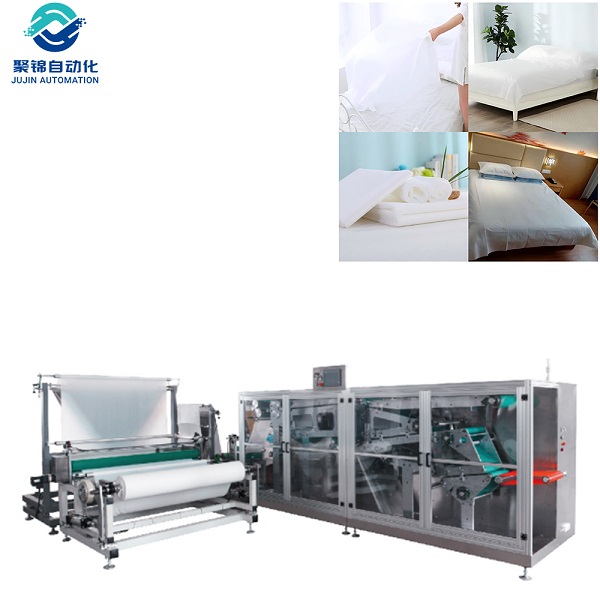
How an Automatic Bed Sheet Folding Machine Works
Understanding the machine begins with understanding its workflow. In a typical automatic bed sheet folding machine, the production process follows this sequential path:
Single-Layer Feeding: A large roll of non-woven fabric (roll diameter up to 1,000 mm) is mounted on the material rack and fed into the machine at a controlled, consistent rate. The feeding mechanism uses cylinder-driven tension control to maintain uniform material delivery.
Triangular Folding: The ultra-wide fabric first passes through a triangular folding station, where guide plates gather the material from both sides and fold it into a narrower profile. This step is critical for reducing a 2,500 mm-wide sheet into a manageable width for subsequent processing.
Longitudinal W-Fold: Following the triangular fold, the fabric undergoes a longitudinal W-fold, which further compacts the material lengthwise. The W-shaped fold pattern ensures uniform layering and prevents shifting during downstream operations.
Finished Product Cutting: At the cutting station, a precision knife separates individual bed sheets from the continuous fabric web. Cutting timing is digitally synchronized with the folding cycle to ensure accurate, repeatable sheet lengths.
Transverse Three-Fold: Each cut sheet then passes through a transverse three-fold station, where a series of folding blades and conveyor belts create three crosswise folds, producing a compact, rectangular package suitable for retail packaging or bulk cartoning.
Finished Product Conveying: The folded sheets are delivered to an output conveyor for counting, stacking, and downstream packaging.
This entire sequence can repeat at speeds of up to 90 pieces per minute on high-performance models, producing thousands of finished sheets per shift without interruption. The coordination between feeding, folding, and cutting is managed by a central PLC system, which ensures that every stage operates in precise synchronization.
Core Components and Their Roles
Each component in a bed sheet folding machine has a specific, critical role. A failure or misalignment in any single part can affect the quality of every sheet produced. Here is a breakdown of what each part does:
1. Material Rack (Unwinding Unit)
This is where the raw non-woven fabric roll is loaded. The material rack supports the roll and controls the angle and tension at which the fabric enters the machine. On wide-format models, the rack is built to handle roll widths of up to 2,500 mm and diameters up to 1,000 mm. Mismanaged unwinding leads to fabric wrinkles, uneven folds, and wasted material.
2. Automatic Tension Control System
One of the most important — and most underappreciated — components of any bed sheet folding machine is the tension control system. Because non-woven fabrics are lightweight and stretch under load, maintaining a perfectly consistent, low-tension feed is essential for producing sheets with accurate, repeatable dimensions. Advanced machines use automatic cylinder-driven tension control, which continuously adjusts the feed force without operator input. This is particularly critical for wide, lightweight fabrics that would otherwise sag, bunch, or tear during high-speed runs.
3. Traction and Feed Rollers
Motorized traction rollers grip the fabric and pull it forward with precision. Speed is synchronized with the folding and cutting cycle to ensure uniform sheet lengths. Modern automatic bed sheet folding machines use servo-driven rollers to synchronize traction speed with downstream operations to within a fraction of a millimeter. Servo motor technology enables high-precision position control and rapid response to changing production parameters.
4. Multi-Stage Folding System
The folding system is the heart of any bed sheet folding machine. Managing a 2.5-meter-wide sheet is impossible by hand, which is why automated multi-stage folding is essential. The sequenced architecture typically includes:
Triangular fold: Gathers fabric from the sides, dramatically reducing width.
Longitudinal W-fold: Folds the fabric lengthwise using precision guide plates.
Transverse three-fold: A series of crosswise folds compacts the sheet into a small, dense square.
5. Cutting Mechanism
Immediately after the longitudinal folding stage, the cutting knife separates individual sheets from the continuous fabric web. The knife must be perfectly synchronized with the folding head — too early and the sheet tears; too late and sheets fuse together. On modern machines, cutting parameters are set digitally through the control panel and are automatically recalculated when the operator changes the target sheet length.
6. Touchscreen PLC Control Panel
The brain of the entire operation. A modern bed sheet folding machine is operated entirely through a touchscreen human-machine interface (HMI). Operators input the desired sheet dimensions, folding specifications, and production speed directly on screen. The PLC (Programmable Logic Controller) then coordinates all servo motors, pneumatic cylinders, and cutting mechanisms accordingly. Changing from one sheet size to another takes minutes, not hours, with no mechanical retooling required. For broader context on how industrial automation is transforming manufacturing, the International Federation of Robotics publishes authoritative data on automation adoption and productivity gains.
Key Technology Trends Shaping 2026
Trend 1: High-Speed, Stable Production
The most notable trend in 2026 is the push toward higher, more stable production speeds. Leading bed sheet folding machines now achieve 90 pieces per minute with consistent quality, compared to 60–70 pieces per minute on older generation models. This improvement comes from better servo motor synchronization, optimized folding blade geometry, and improved material handling systems. For manufacturers, this means higher output per shift and a faster return on equipment investment. At 90 pieces per minute, a single machine running two eight-hour shifts can produce approximately 86,400 folded sheets per day.
Trend 2: Intelligent Multi-Stage Folding
Folding technology has become more sophisticated. Modern machines can execute complex fold sequences — triangular, W-longitudinal, and transverse three-fold — in a single pass, producing compact, uniform packages that are ready for retail packaging. The ability to handle ultra-wide fabrics (up to 2,500 mm) while maintaining fold precision is a key differentiator in 2026. Finished sheet dimensions typically range from 700–800 mm in length and up to 2,000 mm in width before folding, with the final folded package being a fraction of the original size.
Trend 3: Zero-Tension Feeding
As non-woven fabrics become lighter and more delicate, zero-tension feeding has become a standard requirement rather than a premium feature. Automatic cylinder-driven feeding and tension control systems eliminate the need for manual adjustment and prevent stretching, wrinkling, or tearing of the material during high-speed operation. This technology ensures that every sheet maintains consistent dimensions and appearance, reducing scrap rates and improving overall product quality.
Trend 4: Digital Control and Quick Changeover
PLC touchscreen controls have become the industry standard for bed sheet folding machines. The ability to change product specifications by simply inputting new data on a screen — rather than mechanically adjusting components — significantly reduces downtime between production runs. This is especially valuable for contract manufacturers who produce multiple sheet sizes for different clients. Digital control also enables production data logging, fault diagnostics, and remote troubleshooting capabilities.
Trend 5: Energy Efficiency and Optimized Footprint
With energy costs accounting for a significant portion of operating expenses in converting facilities, 2026 models emphasize energy-efficient motor designs and optimized power consumption. Total power draw for a typical wide-format bed sheet folding machine is around 9 kW, which is modest given the machine's throughput. Additionally, manufacturers are optimizing machine footprints — a standard wide-format model measures approximately 10,295 × 4,300 × 2,800 mm (L × W × H) — to fit more efficiently into factory layouts while maintaining accessibility for maintenance.
Trend 6: Integration with Downstream Packaging
A growing trend is the integration of bed sheet folding machines with automatic packaging lines. This creates a fully automated production cell from raw material roll to packaged product, further reducing labor requirements and contamination risks. Conveying mechanisms at the output end are designed to interface seamlessly with counting, stacking, and bagging equipment, enabling uninterrupted production flow.
Technical Specifications: What the Numbers Mean
When evaluating an automatic bed sheet folding machine, buyers should review the following core parameters to ensure the equipment matches their production needs:
| Specification | What It Means for Buyers | Typical Range (Wide-Format Model) |
|---|---|---|
| Production Speed | Higher pieces/min = more output per shift; verify stability at max speed | Up to 90 PCS/MIN |
| Raw Material Width | Must cover your target sheet width plus fold allowances | ≤ 2,500 mm |
| Raw Material Roll Diameter | Larger diameter = fewer roll changeovers per shift | ≤ 1,000 mm |
| Finished Sheet Length | Must cover your product range | 700–800 mm (adjustable) |
| Finished Sheet Width | Maximum unfolded sheet width | ≤ 2,000 mm |
| Fold Configuration | Determines final package size and retail presentation | Triangular + W-longitudinal + 3 transverse folds |
| Power Supply | Check factory voltage and phase compatibility | 380V / 50Hz |
| Total Power | Factor into operating cost calculations | ~9 kW |
| Machine Dimensions | Ensure factory floor space and ceiling height are sufficient | ~10,295 × 4,300 × 2,800 mm |
| Control System | Touchscreen PLC preferred for easy changeover and diagnostics | Full touchscreen HMI with digital input |
| Tension Control | Automatic cylinder-driven preferred for non-woven fabrics | Automatic, no manual adjustment |
Application Scenarios for Disposable Bed Sheets
Because modern bed sheet folding machines accommodate widths up to 2,500 mm, the resulting disposable bed sheets are critical consumables across numerous professional environments:
Hospitals and Medical Clinics: Provides an essential, sterile fluid and dust barrier for examination tables, operating beds, and patient stretchers. Disposable bedding reduces cross-contamination risk and eliminates the need for laundering, which is particularly valuable in high-volume outpatient settings.
SPA and Massage Salons: Used as breathable, soft, and highly hygienic single-use covers for massage beds and cosmetic treatment chairs. The non-woven material offers comfort while ensuring a fresh surface for every client.
Travel and Hospitality: Sold in compact retail travel kits, offering guests a clean, trustworthy bedding solution for hotel stays, sleeper trains, and camping. The compact folded format makes these products easy to distribute and store.
Beauty and Wellness Centers: Single-use sheets maintain hygiene standards between clients in high-turnover environments, reducing laundry costs and simplifying inventory management.
Market Context: Why Demand Is Growing
The market for disposable hygiene products continues to expand globally. Industry research indicates that the non-woven products sector has maintained steady growth, driven by healthcare infrastructure expansion, rising hygiene awareness, and the growth of travel and wellness industries. The global commercial laundry and hygiene equipment market is projected to grow at a compound annual rate of approximately 3–4% through the late 2020s, with post-processing and converting equipment representing a significant share of that growth.
For manufacturers, this growth translates into sustained demand for high-capacity bed sheet folding machines that can produce consistent quality at competitive unit costs. Companies that invest in modern automatic equipment are better positioned to meet increasing order volumes, maintain quality certifications, and compete on both price and reliability. Market intelligence firms such as Smithers provide ongoing research on non-woven and converting market dynamics for those seeking deeper industry analysis.
Buying Guide: How to Select a Bed Sheet Folding Machine
For buyers researching a bed sheet folding machine for sale or evaluating bed sheet folding machine prices, the following checklist provides a structured approach to the procurement decision:
Confirm production capacity requirements: Calculate daily and monthly output targets, then select a machine whose rated speed provides a 15–20% buffer above peak demand. A machine rated at 90 pieces per minute may not sustain that speed continuously with all fabric types.
Verify material compatibility: Ensure the machine can handle your specific non-woven fabric type (spunbond, spunlace, SMS) and gram weight. Lighter fabrics require more sophisticated tension control.
Evaluate fold flexibility: Determine whether your product line requires multiple fold configurations. Some machines offer adjustable transverse fold counts, while others are fixed to a specific fold pattern.
Assess after-sales support: Look for manufacturers that provide installation guidance, operator training, spare parts availability, and a clear warranty policy. A 12-month mechanical parts warranty is standard in the industry.
Check export packaging and delivery: For international buyers, confirm that the manufacturer uses anti-rust treatment, vacuum film, and fumigation-free plywood crating to ensure safe ocean freight.
Request a factory test or video demonstration: Before committing to a purchase, ask to see the machine running with your specific material and product specifications.
Compare total cost of ownership: Beyond the initial bed sheet folding machine price, consider energy consumption, spare parts costs, maintenance requirements, and expected machine lifespan.
Looking for a Reliable Bed Sheet Folding Machine Manufacturer?
JUJIN Automation specializes in high-speed non-woven converting equipment, including automatic bed sheet folding machines with multi-stage folding, zero-tension control, and PLC touchscreen operation. Our engineering team provides tailored solutions, detailed installation support, and responsive after-sales service for clients worldwide.
Request a Quote TodayConclusion
The automatic bed sheet folding machine has become an indispensable asset for disposable hygiene product manufacturers in 2026. Driven by rising labor costs, stricter hygiene standards, and growing global demand for single-use bedding, these machines continue to evolve with higher speeds, smarter controls, and more precise folding technology. The key trends — high-speed stable production, intelligent multi-stage folding, zero-tension feeding, digital quick-changeover controls, energy efficiency, and packaging integration — collectively represent a shift toward fully automated, low-labor production cells.
For buyers, the decision comes down to matching machine specifications to actual production needs, evaluating manufacturer support capabilities, and calculating total cost of ownership rather than focusing solely on upfront price. As the disposable bedding market continues to expand, investing in a well-engineered automatic bed sheet folding machine from an experienced manufacturer remains a sound strategic decision for businesses seeking to scale production while maintaining consistent quality.
Frequently Asked Questions
What is an automatic bed sheet folding machine?
An automatic bed sheet folding machine is industrial converting equipment that transforms large rolls of non-woven fabric into individually cut, multi-folded, and stacked disposable bed sheets through a fully automated sequence of feeding, folding, cutting, and conveying.
How fast can a bed sheet folding machine produce folded sheets?
High-performance bed sheet folding machines can produce up to 90 folded sheets per minute, translating to approximately 5,400 sheets per hour under continuous operation. Actual output depends on fabric type, sheet dimensions, and fold complexity.
What raw materials are compatible with these machines?
Most automatic bed sheet folding machines are designed for non-woven fabrics, including spunbond, spunlace (water-entangled), and SMS composite materials. Typical roll specifications are up to 2,500 mm in width and 1,000 mm in diameter.
What is the typical power consumption of a bed sheet folding machine?
A standard wide-format automatic bed sheet folding machine typically draws around 9 kW of total power at 380V / 50Hz, though actual consumption varies by production speed and machine configuration.
How do I choose the right bed sheet folding machine manufacturer?
Evaluate manufacturers based on technical specifications (speed, width capacity, fold types), after-sales support including installation and warranty, compliance with export packaging standards, and proven experience in non-woven converting equipment. Request a demonstration with your specific material before purchasing.
Can the machine handle different sheet sizes?
Yes. Modern machines with PLC touchscreen controls allow operators to input different sheet dimensions and folding specifications digitally, enabling quick changeovers between product sizes without mechanical retooling. Finished sheet length is typically adjustable within the machine's rated range.
What maintenance is required for a bed sheet folding machine?
Routine maintenance includes regular lubrication of moving parts, inspection of cutting blades for sharpness, calibration of tension control systems, and cleaning of sensors and conveyor belts. Most manufacturers provide a maintenance schedule as part of the operator manual.


