


What Is a Disposable Bathrobe Making Machine and How Does It Work?
That soft, lightweight white bathrobe waiting in a hotel bathroom — sealed in plastic, worn once, and thrown away — starts as a wide roll of nonwoven fabric. Within seconds, an automatic nonwoven bathrobe machine turns that roll into a finished, folded, sealed robe, ready for a single guest. But how does that transformation actually happen? This guide explains the whole process in plain language.
Key Takeaways
A disposable bathrobe making machine converts a roll of nonwoven fabric into finished, single-use bathrobes through a continuous automated sequence of unwinding, sealing, cutting, folding, and stacking.
Most disposable bathrobes are made of polypropylene (PP) spunbond nonwoven fabric, typically 20–50 g/m² — soft, breathable, low-lint, and inexpensive enough to use once and discard.
The core components are the material rack, servo-driven tension system, traction rollers, ultrasonic sealing unit, cutting mechanism, folding system, and a PLC touchscreen panel.
Ultrasonic welding replaces thread and glue, producing smooth edges with no needle holes — a real advantage in hygiene-sensitive settings.
A fully automatic line is normally supervised by a single operator and runs continuously; output depends on robe size, style, and folding complexity.
What Is a Disposable Bathrobe Making Machine?
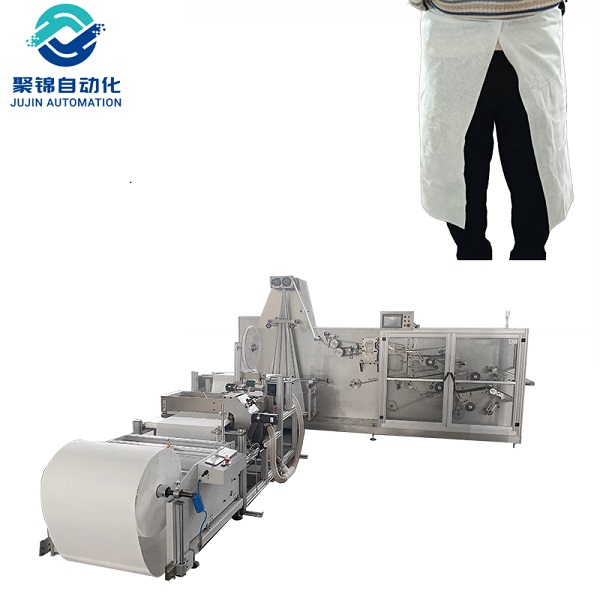
A disposable bathrobe making machine is industrial converting equipment that takes a roll of nonwoven fabric and automatically turns it into finished, single-use bathrobes. It is also described as a nonwoven bathrobe machine, a spa wrap machine, or the core of a disposable robe production line. The key point is that no hand sewing, no manual cutting, and no operator intervention are needed between cycles — the machine feeds the fabric, forms the robe, seals the edges, cuts it free, folds it, and stacks it in one continuous process.
These machines are common in factories that supply hotels, resorts, spas, cruise ships, clinics, beauty salons, and other businesses that need a clean garment for every customer. Because the final product is used once and discarded, the equipment is designed for high speed, low labor input, and consistent quality at a very low unit cost.
Why Disposable Bathrobes Are Made of Nonwoven Fabric
Understanding the machine starts with understanding the material. A disposable bathrobe is not woven or knitted like a normal towel or shirt. It is made of nonwoven fabric — a sheet of fibers bonded together by heat, pressure, or chemicals instead of being spun and woven into yarn. The most common material for disposable bathrobes is polypropylene (PP) spunbond nonwoven, produced by extruding melted polymer into fine continuous filaments and bonding them into a web. The result is a fabric that is soft, breathable, lightweight, resistant to tearing, and cheap enough to throw away after one use. The nonwovens industry association EDANA and the Association of the Nonwoven Fabrics Industry (INDA) both publish detailed background on how these engineered fabrics are made and where they are used.
Fabric weight, measured in grams per square metre (g/m², also called GSM), is the most important specification for a disposable bathrobe. It directly affects softness, opacity, strength, and cost. Common choices are shown below.
| Material | Typical GSM | What It Means for the Robe |
|---|---|---|
| PP spunbond (light) | 20–30 g/m² | Soft and very economical; common for large-volume guest robes and event wear |
| PP spunbond (standard) | 30–45 g/m² | Better drape and strength; the most common choice for hotel, spa, and salon bathrobes |
| SMS composite (spunbond–meltblown–spunbond) | 35–50 g/m² | Adds a barrier layer; used when a higher level of liquid resistance or protection is required |
How the Full Production Process Works — Step by Step
In a typical disposable bathrobe making machine, the process follows a fixed sequential path. Each stage is synchronized with the others by the machine's control system so the fabric moves through without stopping.
Unwinding: A large roll of nonwoven fabric is mounted on the material rack and fed into the machine. Roll diameters up to about 800 mm are common, because a bigger roll means fewer changeovers per shift.
Tension control and feeding: Servo-driven rollers grip the fabric and pull it forward at a constant, low tension. Lightweight nonwoven stretches easily, so precise tension control prevents wrinkles, wandering, and wasted material at high speed.
Fastening application (optional module): For bathrobes and spa wraps that need a secure closure, the line can glue an elastic waistband and ultrasonically weld Velcro (hook-and-loop) fasteners in place while the fabric is moving.
Ultrasonic sealing: High-frequency vibration bonds the fabric layers together along the edges, forming hems, seams, and cuffs without thread, glue, or needle holes. The edge is soft enough to sit against bare skin and strong enough to resist tearing.
Cutting: A cutter, synchronized with the sealing unit, separates each individual robe from the continuous web. Sealing and cutting happen in the same cycle so the cut edge is already sealed and will not fray.
Folding: The robe is folded automatically — typically a W-shaped longitudinal fold followed by several transverse folds — compressing a large piece of fabric into a compact, retail-ready square.
Stacking and counting: Finished robes are delivered to a collection station where they are counted and stacked, ready for packaging and distribution.
This entire sequence runs continuously. The output of a fully automatic line is usually measured in metres of fabric converted per minute, and the number of robes per minute depends mainly on robe length and how many folds the design requires.
The Main Components of a Disposable Bathrobe Making Machine
Each component has a specific role, and a misalignment in any one of them can affect the quality of every robe produced. Here is what each part does.
1. Material Rack (Unwinding Unit)
This is where the raw nonwoven roll is loaded. The rack supports the roll and controls the angle at which the fabric enters the machine, so unwinding stays smooth and wrinkle-free.
2. Servo Tension Control System
Wide, lightweight nonwoven fabric stretches and wanders easily. Multi-axis servo motors continuously adjust the feed force to keep tension near zero, which is essential for accurate, repeatable robe dimensions at high speed.
3. Traction and Feed Rollers
These rollers determine how far the fabric advances per cycle, which directly controls the finished robe's length. On modern machines they are servo-synchronized with the sealing and cutting units to within a fraction of a millimetre.
4. Ultrasonic Sealing Unit
The heart of a nonwoven bathrobe machine. An ultrasonic generator, transducer, and horn convert electrical energy into high-frequency mechanical vibration (typically around 20 kHz). The vibration melts and fuses the fabric at the contact point, creating a strong, sealed, and clean edge without any consumable thread or glue.
5. Cutting Mechanism
Immediately after sealing, the cutting knife separates the robe from the fabric web. The knife must be perfectly synchronized with the sealing head — too early and the seal tears, too late and the robes fuse together.
6. Folding System
A large piece of nonwoven must be compressed into a small package for shipping and sale. The folding system performs a sequenced longitudinal W-fold followed by transverse folds, turning a large robe into a neat square ready for bagging.
7. PLC Touchscreen Control Panel
The brain of the operation. Operators enter the desired robe length, sealing parameters, and folding settings directly on a touchscreen. The PLC then coordinates all servo motors, ultrasonic generators, and pneumatic cylinders. Changing from one robe size to another takes minutes, not hours, with no mechanical retooling.
| Component | Primary Function | Key Feature on Modern Machines |
|---|---|---|
| Material Rack | Supports and unwinds the nonwoven roll | Handles rolls up to about 800 mm in diameter |
| Tension Control System | Maintains consistent, low-tension fabric feed | Multi-axis servo control, no manual adjustment |
| Traction and Feed Rollers | Control fabric advance speed and robe length | Servo-synchronized with sealing and cutting |
| Ultrasonic Sealing Unit | Bonds edges and seams without thread or glue | ~20 kHz ultrasonic welding, smooth sealed edges |
| Cutting Mechanism | Separates each robe from the web | Digital synchronization with the sealing cycle |
| Folding System | Compacts large robes for distribution | Longitudinal W-fold plus transverse folds |
| PLC Touchscreen Panel | Central machine control and programming | Full digital input, fast size changeover |
Single Machine or Full Production Line?
Buyers evaluating equipment will meet both single machines and complete production lines. The right choice depends on production volume, available labour, and budget. The comparison below is a useful starting point.
| Factor | Single Machine | Full Automatic Production Line |
|---|---|---|
| Process steps handled | One or a few steps | Unwinding, fastening, sealing, cutting, folding, stacking |
| Speed and output | Moderate | High, continuous output |
| Labour required | More manual handling | Typically 1–2 operators |
| Investment | Lower | Higher, but lower cost per piece |
| Best suited for | Small workshops, short runs | Factories producing large daily volumes |
Why the Sealing Method Matters
For nonwoven garments, ultrasonic sealing has replaced traditional sewing in most modern nonwoven bathrobe machine designs, and the reason is technical rather than cosmetic. Sewing creates needle holes along every seam, which can weaken the fabric and, in hygiene-critical settings, can be a route for contamination. Ultrasonic welding creates a continuous bond with no holes, no thread, and no loose edges. The process is also faster, does not consume needles or thread, and produces a soft, smooth edge that is comfortable against the skin. The result is a stronger, cleaner, more consistent seam at a lower running cost.
Hygiene and Why Disposable Bathrobes Matter
The main reason hotels, spas, clinics, and cruise ships choose disposable garments is straightforward: a single-use product eliminates the risk of cross-contamination between guests. There is no washing, no shared inventory, and every customer gets a fresh, sealed robe. In medical and hygiene settings, barrier performance is formally graded. The U.S. Food and Drug Administration, in its guidance on medical gowns, recognizes the ANSI/AAMI PB70 standard, which classifies protective apparel into four levels of liquid barrier performance. The Centers for Disease Control and Prevention (CDC) similarly describes how protective clothing and personal protective equipment are selected according to exposure risk. Not every disposable bathrobe needs the highest grade — but buyers serving medical or high-risk markets should know which level their product must meet.
| Barrier Level | Risk Level | Typical Use |
|---|---|---|
| Level 1 | Minimal risk | Basic care, standard isolation, visitor cover gown |
| Level 2 | Low risk | Blood draw, suturing, intensive care unit |
| Level 3 | Moderate risk | Arterial blood draw, IV insertion, emergency room |
| Level 4 | High risk | Surgery and fluid-intense procedures |
Key Technical Specifications to Evaluate When Buying
When evaluating any nonwoven bathrobe machine, buyers should check the following parameters to make sure the equipment matches their production plan and budget.
| Specification | What to Look For | Typical Range |
|---|---|---|
| Production speed | Higher throughput means more robes per shift | Commonly 50–80 m/min on fully automatic lines |
| Finished product length | Must cover your target robe size | Commonly 600–1000 mm for spa-wrap styles |
| Raw material roll diameter | Larger roll means fewer changeovers | Up to about 800 mm |
| Sealing method | Ultrasonic preferred for nonwoven fabric | ~20 kHz ultrasonic welding |
| Control system | Touchscreen PLC for easy changeover | Full digital parameter input |
| Power supply | Match your factory voltage | 380V / 50Hz typical |
| Operator requirement | Lower labour means lower running cost | 1–2 operators per fully automatic line |
Common Applications of Disposable Bathrobes
A single machine model can serve many end markets, because the same core process — feeding nonwoven, sealing, cutting, folding — applies to most single-use garments. Typical applications include:
Hotels and resorts: fresh guest bathrobes and bathroom amenities
Spas and wellness centres: lightweight spa wraps for every treatment
Cruise ships: compact single-use robes that save storage and laundry
Hospitals and clinics: patient robes and isolation garments
Beauty salons, massage and tattoo studios: hygienic garments for clients
Airlines: sleepwear and comfort items on long-haul flights
Dental and medical aesthetics: disposable protection for each patient
Conclusion
A disposable bathrobe making machine is a compact example of industrial automation: a roll of inexpensive nonwoven fabric goes in, and sealed, folded, ready-to-use bathrobes come out, with minimal labour and no sewing. The material science of spunbond polypropylene explains why the product can be soft, strong, and cheap at the same time, while ultrasonic sealing and servo-driven tension control explain how the machine keeps quality consistent at high speed. For a business that needs clean, single-use garments in volume, this type of equipment offers a direct path from raw fabric to finished product at a predictable cost per piece.
Frequently Asked Questions
It is an automated machine that converts rolls of nonwoven fabric into finished single-use bathrobes — including sealing, cutting, folding, and stacking — with very little manual labour.
Most are made of polypropylene (PP) spunbond nonwoven fabric, usually 20–50 g/m². Some products use SMS composites when a higher level of liquid resistance is needed.
Ultrasonic welding bonds the fabric with high-frequency vibration, so there are no needle holes, no thread, and no loose edges. It is faster, cleaner, and leaves a soft, smooth edge that is comfortable against the skin.
Output depends on robe size, style, and folding complexity. Fully automatic lines convert fabric continuously, commonly at 50–80 m/min, so pieces per minute vary with the robe length being produced.
A single machine handles one or a few process steps and needs more manual handling. A full line integrates unwinding, fastening, sealing, cutting, folding, and stacking into one continuous process for higher speed and lower labour.
Yes. On PLC-controlled machines, operators change robe length, sealing parameters, and folding settings on the touchscreen — usually within minutes and without mechanical retooling.
Looking for a Reliable Disposable Bathrobe Making Machine Manufacturer?
JUJIN builds fully automatic nonwoven disposable garment production equipment, including an 8-servo line with ultrasonic sealing, elastic and Velcro fastening, and smart auto-folding. Factory-direct support, customized configurations, and worldwide delivery make it easier to start or scale disposable robe production.
Get a Free Quote from JUJINView JUJIN's Nonwoven Bath Skirt Production Line →


