


5 Key Technical Parameters to Check When Selecting a PE Apron Making Machine
Every year, billions of single-use protective aprons are consumed across food processing facilities, hospital wards, veterinary clinics, and commercial kitchens worldwide. Behind each of those aprons is an industrial machine — a PE apron making machine — operating continuously to meet that demand. For factory owners, operations managers, and procurement teams preparing to invest in a disposable apron production line, choosing the right equipment comes down to more than brand recognition or price. The five technical parameters covered in this guide are the measurable specifications that determine real-world output quality, production efficiency, and long-term return on investment for any disposable apron making machine deployment.
Key Takeaways
Production speed should be evaluated as a stable continuous-run figure, not a quoted peak-capacity number from a specification sheet.
PE tubular film compatibility — not flat-film processing — is essential for producing seamless, tear-resistant disposable aprons at commercial quality.
A synchronized die-forming station separates a precision apron cutting machine from a basic punching system that loses output time on every cut cycle.
A 4-fold transverse output system is the practical minimum for integrating production with downstream automated packaging equipment.
Touchscreen HMI with automatic cylinder-driven tension control eliminates manual film adjustment and reduces material waste across a full production shift.
Why These Parameters Matter Before Purchasing a PE Apron Making Machine
The global demand for disposable protective apparel has expanded steadily, driven by tighter food safety regulations and growing healthcare infrastructure in emerging markets. Disposable PE aprons — waterproof, single-use protective garments worn in meatpacking plants, dental clinics, and institutional kitchens — must meet consistent dimensional and structural standards to function as reliable barrier protection. Under OSHA's PPE standards, fluid-resistant disposable aprons used in healthcare and food processing environments are formally classified as personal protective equipment, which places direct quality demands on every machine that produces them.
A PE apron making machine that cannot sustain consistent film tension, precise die-cut registration, or uniform folding will generate defective output — wasted raw material, rejected batches, and fulfillment delays that damage supplier relationships. For buyers evaluating disposable apron making machines for commercial deployment, the five parameters below provide the most reliable framework for equipment comparison and supplier qualification.
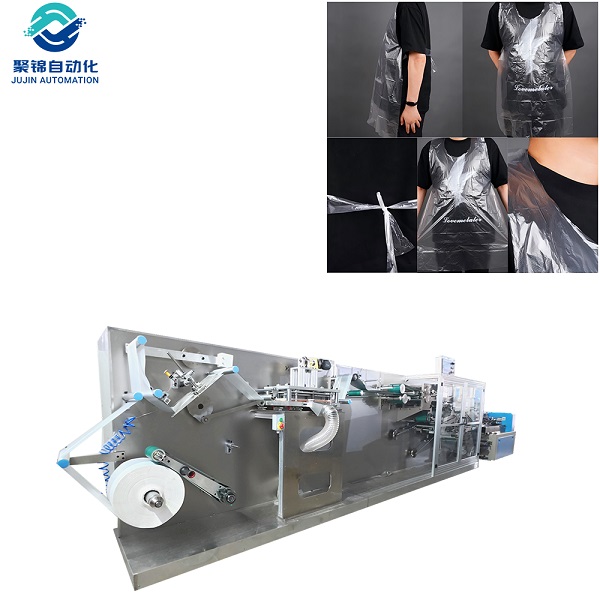
Parameter 1: Production Speed — Stable Continuous Output, Not Peak Figures
Production speed is the most prominently cited figure in any PE apron making machine specification sheet, and it is also the most commonly misunderstood. Most equipment suppliers quote a rated maximum speed expressed in pieces per minute (PCS/MIN). What procurement teams should request is the stable continuous-run speed — the output rate the machine sustains over a complete 8-hour shift without mechanical slowdown caused by heat buildup in the sealing components, tension drift in the film feed, or pneumatic pressure loss in the cylinder systems.
For commercially deployed disposable apron making machines, a stable, uninterrupted output of 50 PCS/MIN represents the established benchmark for industrial-scale production. At this rate, a single machine operating across two shifts per day can produce approximately 48,000 finished aprons — sufficient to fulfill the order volumes of large institutional buyers in foodservice supply, hospital procurement, and hotel amenity distribution.
What to Verify from Any Supplier
Stable rated speed vs. documented actual shift output — request production records, not only specification sheets
Speed consistency when running at full finished product dimensions (e.g., 950 mm length × 300 mm width)
Whether the advertised speed applies to the full production cycle including die-forming and folding, or only to the cutting stage in isolation
| Output Speed Tier | Approx. Output per 8-Hour Shift | Typical Production Context |
|---|---|---|
| Below 30 PCS/MIN | ~14,000 units | Low-volume runs or product trials |
| 30–49 PCS/MIN | 14,400–23,500 units | Mid-scale regional supply |
| 50 PCS/MIN | ~24,000 units per shift | Commercial bulk order fulfillment |
| 50+ PCS/MIN | 24,000+ units per shift | High-volume export production lines |
Parameter 2: Raw Material Compatibility — PE Tubular Film Specification
The type and dimensional specification of PE film a machine is engineered to process is the second most critical parameter — and one that directly determines the structural quality of the finished apron.
Polyethylene (PE) film combines moisture resistance, chemical stability, and structural flexibility, which makes it the preferred raw material for disposable protective apparel across healthcare and food processing industries. However, not all PE film formats are suitable for apron manufacturing. The two main processing options are flat PE film and PE tubular film — and they produce fundamentally different products.
Why Tubular Film Is the Correct Format for Disposable Apron Production
A PE apron making machine designed for tubular film processes a seamless cylindrical sleeve of polyethylene. As the tubular film is opened and advanced through the machine, both lateral edges of the apron are formed naturally from the continuous film wall — without any secondary heat-sealing step along the sides. The result is a finished apron with seamless longitudinal edges, producing a structurally superior neck and shoulder area with significantly higher tear resistance under tension.
For healthcare workers who don and remove aprons repeatedly throughout a shift, or food processing workers who bend and reach during active use, this structural integrity is not a minor detail — it is a functional protection requirement. Machines listed as compatible only with flat PE film are not suitable substitutes: the flat-film apron relies on a heat-sealed seam at both side edges, introducing a structural weak point that is more prone to failure under load.
Critical Film Specifications to Confirm Before Ordering
Film width: The standard format for commercial disposable aprons requires a PE tubular film flat width of 300 mm. The machine's forming and folding stations must be calibrated to this dimension.
Roll diameter capacity: A commercial disposable PE apron machine should accept film rolls up to at least 700 mm in outer diameter. Larger roll capacity means fewer raw material changeovers per shift, directly reducing production downtime.
Film grade compatibility: LDPE (low-density polyethylene) tubular film is the standard raw material for this product category. Suppliers should confirm that their machine is optimized for LDPE processing rather than mixed-grade film formats.
Parameter 3: Die-Forming Station Precision — Synchronized Cutting Without Speed Loss
The functional identity of a disposable PE apron is defined by two specific structural features: the neck opening that allows the apron to rest on the wearer's shoulders, and the waist tie strips that secure the apron at the back. Both are created at the die-forming station — the mechanical component that punches the neck hole profile and cuts the tie geometry from the film in a single coordinated action during continuous production.
Synchronized vs. Stop-Cut Die Systems
The performance gap between a precision die-forming station and a basic punching unit comes down to synchronization with the film feed. On well-engineered PE apron making machines, the die-forming head moves in synchronized motion with the advancing film — stamping the neck opening and tie profiles at precisely the correct position on each apron without halting the film feed or reducing line speed. On lower-specification machines, the film feed must pause momentarily for each die-cut cycle. These brief stops accumulate into meaningful output losses over a shift and introduce positional variation in the cut pattern that results in aprons with inconsistent neck hole placement and off-center tie cuts.
In industrial film converting, die-cutting precision depends on coordinated pressure application and exact blade alignment — small mechanical tolerances compound into significant defect rates at high production speeds, making synchronization a non-negotiable requirement for commercial-grade output.
What to Evaluate When Comparing Machines
Confirm whether the die-forming head operates in synchronized motion with the film feed, or requires a stop-cut pause on each cycle
Request tolerance specifications on the neck hole punch position — precision should be within ±1–2 mm across a continuous shift run
Ask whether die molds for alternate apron body profiles (different neck shapes or tie configurations) are available as optional tooling accessories
Parameter 4: Folding System Architecture — Fold Count and Output Compactness
Once the apron body has been die-formed to shape and cut to length, the folding system takes over — and this is where many entry-level disposable apron making machines fall short of commercial production requirements. The folding sequence determines both the compactness of the finished product and its compatibility with downstream packaging equipment.
The Standard Multi-Stage Fold Sequence
A commercially capable PE apron making machine executes the folding process in multiple coordinated stages:
One-third longitudinal fold — the apron is folded lengthwise to an initial reduced width
Longitudinal wrapping fold — a secondary fold aligns the apron into its final pre-pack width profile
Transverse 4-fold — the apron is folded crosswise four times in succession, compressing a finished length of 950 mm into a compact, stackable square
Why a 4-Fold Output System Matters for Commercial Operations
The commercial significance of the 4-fold transverse system is its output compatibility with downstream automated packaging equipment. Aprons exiting the conveying mechanism in a consistent, compact format can feed directly into automatic counting, stacking, and bagging machines — eliminating the manual handling step that otherwise acts as a production bottleneck between the apron cutting machine output and the packaging line.
Machines that produce a loosely folded or dimensionally inconsistent output require a manual refolding step before packaging can proceed. This negates a significant portion of the efficiency advantage that a fully automatic production line is designed to deliver, and introduces a labor cost that compounds across every shift.
| Folding Stage | Direction | Function |
|---|---|---|
| One-Third Fold | Longitudinal | Initial width reduction of the apron body |
| Wrapping Fold | Longitudinal | Final width profile alignment before transverse folding |
| Transverse 4-Fold | Crosswise (×4) | Length compression from 950 mm to compact output square |
Parameter 5: Control System and Automation Level
The fifth parameter — and the one that most directly affects day-to-day operational cost and consistency — is the machine's control and automation architecture. Two core subsystems define the effective automation level of any disposable PE apron machine.
Touchscreen HMI (Human-Machine Interface)
Modern PE apron making machines replace mechanical adjustment knobs and manual switch panels with a touchscreen control panel connected to a PLC (Programmable Logic Controller). Operators input target production parameters — including cutting position, folding specifications, and line speed — directly through the touchscreen. The PLC coordinates all mechanical subsystems accordingly, eliminating the need for physical retooling when changing apron specifications. This reduces changeover time from several hours to minutes and significantly lowers the skill threshold for routine machine operation — a practical advantage for production facilities that experience regular staff rotation.
Automatic Cylinder-Driven Tension Control
PE tubular film is elastic — it stretches under tension and relaxes when tension is released. Manual film tension adjustment by operators introduces shift-to-shift variability that is difficult to correct in real time: excess tension narrows the film and distorts finished apron dimensions; insufficient tension causes the film to sag, wrinkle, and misalign at the die-forming station, generating defective cuts across entire production runs.
An automatic cylinder-driven tension control system continuously monitors and adjusts the film feed force throughout the production run without any operator input. This maintains consistent film geometry from the first apron to the last piece in a shift, producing a uniform finished product and substantially reducing material waste caused by tension-related misalignment. Together, the touchscreen HMI and automatic tension control are what distinguish a professional-grade disposable apron making machine from lower-tier alternatives that depend on constant operator attention to maintain output quality.
Full Technical Specification Reference Table
| Technical Parameter | What to Evaluate | Commercial Benchmark |
|---|---|---|
| Production Speed | Stable continuous-run PCS/MIN (not peak spec) | 50 PCS/MIN |
| Tubular Film Width | Film flat-width compatibility | 300 mm |
| Film Roll Diameter | Maximum roll outer diameter accepted | ≤700 mm |
| Die-Forming Method | Synchronized motion vs. stop-cut cycle | Fully synchronized, no stop-cut pause |
| Folding System | Fold count, sequence, and output consistency | 4-fold transverse + longitudinal stages |
| Finished Apron Size | Length × Width of finished product | 950 mm × 300 mm (standard) |
| Control System | Interface type and tension control method | Touchscreen PLC + auto cylinder tension |
| Power Supply | Voltage and phase configuration | 380V / 50Hz (three-phase) |
| Operating Power Draw | Actual power consumption at rated speed | ~10 kW |
| Machine Footprint | Floor space required (L × W × H) | 6,000 × 1,200 × 1,620 mm |
Summary
Selecting the right PE apron making machine is not a decision that should rest on price alone or on the persuasiveness of a supplier's sales materials. The five technical parameters outlined in this guide — production speed, raw material compatibility, die-forming precision, folding system architecture, and automation level — represent the functional benchmarks that determine whether a disposable apron making machine will meet the output quality and operational efficiency that commercial-scale production demands. Procurement teams that evaluate potential apron making machine manufacturers against these specific, measurable criteria will be significantly better positioned to make a sound capital investment and avoid the hidden costs of underperforming equipment: wasted film, high defect rates, and manual handling labor that offsets the value of automation.
Looking for a Reliable PE Apron Making Machine Manufacturer?
JUJIN, based in Changzhou, Jiangsu Province, China, specializes in factory-direct manufacturing of automatic PE apron making machines built for commercial-scale disposable apron production. Their equipment delivers a stable 50 PCS/MIN output, processes PE tubular film rolls up to 700 mm diameter, features a synchronized die-forming station, an integrated 4-fold output system, and full touchscreen HMI with automatic cylinder-driven tension control — all from a single factory-direct source with a 12-month mechanical parts warranty and worldwide delivery support.
Request a Free Quote from JUJIN →Frequently Asked Questions
What is the ideal production speed for a commercial PE apron making machine?
For commercial-scale production, a stable, continuous output of at least 50 PCS/MIN is the standard benchmark. Buyers should request documented shift-output records from suppliers rather than relying solely on peak capacity figures listed in a specification sheet.
Why does a PE apron making machine use tubular film instead of flat PE film?
Tubular PE film allows the machine to form seamless longitudinal edges on both sides of the apron without any additional heat-sealing steps. This creates a structurally stronger neck and shoulder area with higher tear resistance — a critical quality requirement for aprons used in healthcare and food processing environments.
What does a 4-fold system mean on a disposable apron making machine?
A 4-fold system folds the finished apron four consecutive times crosswise after the longitudinal fold, compressing a 950 mm apron into a compact, uniform square. This output format is required for direct integration with downstream automatic bagging and packaging equipment.
What maximum roll diameter should a PE apron making machine support?
A commercially capable machine should accept PE tubular film rolls up to at least 700 mm in outer diameter. Larger roll capacity means fewer material changeovers per shift, reducing downtime and maintaining output continuity.
How difficult is it to operate a fully automatic disposable apron making machine?
On a machine equipped with a touchscreen HMI and automatic tension control, routine operation is straightforward. Folding positions, cutting parameters, and line speed are adjusted by entering values on screen — no mechanical retooling is required for standard specification changes.
What power supply does an industrial PE apron making machine require?
Most industrial PE apron making machines operate on 380V / 50Hz three-phase power with a typical operating power draw of approximately 10 kW. Buyers should confirm that their facility's power supply configuration matches the machine's requirements before placing an equipment order.
Can a PE apron making machine connect directly to an automatic packaging line?
Yes — machines with an integrated multi-fold output system produce aprons in a consistent, compact folded format that can feed directly into automatic counting, stacking, and bagging equipment, eliminating manual handling between the production and packaging stages.


