


Non Woven Extrusion Lamination: A Complete Guide to the Process, Benefits, and Applications
Every day, millions of hygiene products, medical gowns, and industrial packaging materials depend on a quiet industrial step: a roll of soft nonwoven fabric meeting a thin curtain of molten polymer and being pressed together in a fraction of a second. That step is called Non Woven Extrusion Lamination, and the equipment behind it is an extrusion lamination machine. This guide explains how the process works, which materials are involved, why manufacturers choose it, and where the finished laminates are used. Buyers will also find practical guidance for purchasing an extrusion lamination machine for their production line.
Key Takeaways
The process bonds a nonwoven fabric to a molten polymer film in one continuous step, with no adhesive.
The core line is made up of an unwinder, an extruder with a flat die, a chilled nip, and a winder; tension and temperature control decide the quality.
Glue-free bonding creates strong, waterproof, and often breathable laminates at a lower running cost than adhesive lamination.
Hygiene, medical, and packaging are the three largest application areas for laminated nonwoven composites.
What Is Non Woven Extrusion Lamination?
Non Woven Extrusion Lamination is a converting process in which a layer of molten polymer is extruded through a flat slot die onto a moving nonwoven substrate. The polymer curtain and the fabric pass together through a nip formed by a chilled roll and a pressure roll, where the hot film is pressed into the fiber surface. As the film cools, it locks onto the fabric by mechanical anchoring, with no glue, solvent, or adhesive in the product. The result is a composite sheet that keeps the softness and strength of the nonwoven and adds the barrier performance of the polymer film.
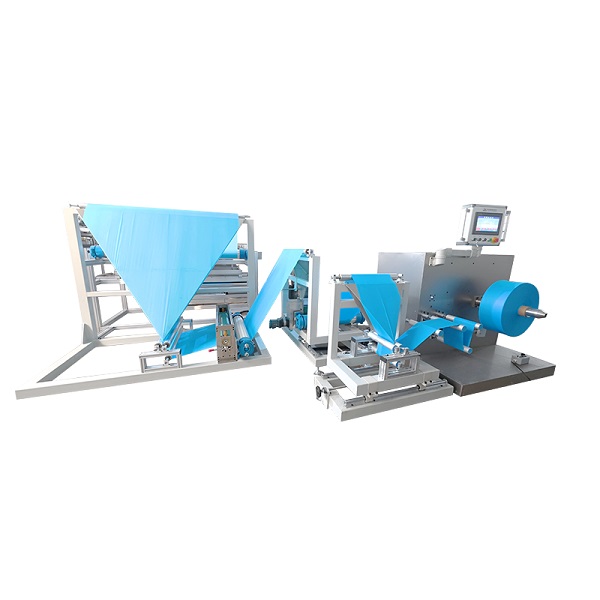
Nonwovens themselves are defined by ISO 9092, the international standard that defines nonwoven materials, as engineered fibrous assemblies given structural integrity by physical or chemical means, excluding weaving, knitting, and papermaking. The Association of the Nonwoven Fabrics Industry and EDANA, the association for nonwovens and related industries, publish detailed background on how nonwovens are produced and used. An extrusion lamination machine performs the lamination step in a single line: unwinding the fabric, extruding the film, bonding, cooling, and rewinding.
How the Process Works — Step by Step
Although machine layouts differ, every lamination line follows the same logical sequence. The steps below describe a typical single-sided line.
Unwinding. The nonwoven substrate is mounted on an unwind stand. Rolls up to about 800 mm in diameter are common on compact lines, because a larger roll means fewer changeovers.
Surface treatment (optional). A corona treater raises the surface energy of the fabric, which improves the adhesion of the molten film on low-energy polymers such as polypropylene.
Polymer extrusion. PE or PP pellets are melted in the heated barrel of the extruder, filtered to remove contaminants, and pumped through a flat slot die as a uniform molten curtain. Melt temperatures typically sit in the range of 270–330 °C for LDPE, with lower values preferred when coating lightweight nonwovens to avoid heat damage to the fibers.
Film application and nip bonding. The molten film meets the moving fabric in the nip between a water-cooled chill roll and a pressure roll. The pressure embeds the polymer into the fiber surface, and the chill roll extracts heat to set the film.
Cooling and edge trimming. The laminate is cooled, its edges are trimmed to the working width, and trim waste is removed automatically on well-designed lines.
Winding and quality control. The finished roll is wound under constant tension. Operators sample coating weight, film thickness, and bond strength against the specification.
Three process variables deserve special attention because they control most quality issues. Melt temperature must be high enough for the polymer to flow and oxidize slightly for adhesion, but low enough to avoid degrading the nonwoven fibers. The air gap between the die and the nip influences how much the film is drawn down and how much oxidation occurs. Nip pressure and chill roll temperature decide how deeply the polymer penetrates the fiber surface and how quickly the laminate sets. On modern lines these values are entered digitally and held automatically, which is why a compact machine can produce consistent rolls all day.
| Stage | What Happens | Key Control |
|---|---|---|
| Unwinding | Nonwoven web feeds into the line | Tension and web alignment |
| Surface treatment | Corona discharge raises surface energy | Treatment power vs. line speed |
| Extrusion | Polymer melts and exits the slot die | Barrel and die temperatures |
| Nip bonding | Film pressed into fabric, then cooled | Nip pressure, chill roll temperature |
| Trimming | Edges cut to finished width | Trim position and removal |
| Winding | Laminate wound into rolls | Winding tension, roll hardness |
Technical associations such as TAPPI, the technical association for the converting and packaging industry, maintain extensive extrusion coating knowledge that process engineers use to set these parameters correctly.
Key Components of an Extrusion Lamination Machine
Buyers comparing machine options will meet the same core components on every line; the differences are in precision, speed, and control. The table below summarizes each part and its role.
| Component | Primary Function |
|---|---|
| Unwind stand and web guide | Holds the nonwoven roll and keeps the web aligned |
| Tension control system | Maintains constant tension to prevent stretching and wrinkling; full-servo or cylinder-driven types are most consistent |
| Extruder | Melts and homogenizes the polymer at controlled temperatures |
| Screen changer / melt filter | Removes contaminants and gels from the melt |
| Flat slot die | Distributes the melt into a uniform film; adjustable lip controls thickness |
| Corona treater (optional) | Raises substrate surface energy for stronger adhesion |
| Chill roll and nip roll | Bond the film to the fabric and cool it to set the laminate |
| Edge trim and waste removal | Cut and remove trim for clean edges and stable operation |
| Winder | Winds the finished laminate at constant tension |
| HMI touchscreen control | Sets speed, coating thickness, and tension parameters |
Modern control has changed how these components work together. Full-servo drives synchronize unwinding, extrusion, and winding so the web never stretches or wrinkles, even at high speed. A touchscreen panel stores recipes for different materials, so an operator can switch from a spunbond hygiene laminate to a stiffer packaging laminate by changing parameters rather than hardware. Compact high-speed lines in this class typically process rolls up to 800 mm in diameter and widths around 600 mm, with production speeds of 100 m/min, which keeps the unit cost low for volume converting.
Materials Used in Non Woven Extrusion Lamination
Two material families matter in this process: the nonwoven substrate and the polymer film. Common nonwoven substrates include spunbond polypropylene, meltblown, SMS (spunbond–meltblown–spunbond), and spunlace. The polymer is most often low-density polyethylene (LDPE), chosen for its low cost, easy processing, and soft hand feel; LLDPE, PP, EVA, and EMA are used when more toughness, heat resistance, or adhesion to a specific film is needed.
| Material | Typical Role | Why It Is Used |
|---|---|---|
| Spunbond PP nonwoven | Substrate | Soft, strong, and economical base for hygiene and medical products |
| Meltblown | Substrate layer | Fine fibers add filtration and barrier properties |
| SMS composite | Substrate | Combines barrier and strength for medical drapes and gowns |
| Spunlace | Substrate | Fabric-like softness for premium wipes and apparel |
| LDPE | Film | Most common coating resin; soft, waterproof, low cost |
| LLDPE | Film | Adds toughness and puncture resistance |
| PP | Film | Higher heat resistance and stiffness |
| EVA / EMA | Film | Better adhesion to difficult substrates |
Coating thickness is set by the die gap, the extruder output, and the line speed. Typical values for nonwoven lamination range from about 10 to 40 microns, which corresponds to roughly 10–40 g/m² of polymer. Thinner coatings are used where softness and breathability matter, while thicker coatings create stiffer barrier films for demanding packaging.
Adhesion is governed by surface energy. Polypropylene nonwovens have low surface energy, which is why corona treatment is used to prepare the web. Polyethylene film bonds readily to a treated substrate, but heavy coating weights can stiffen the laminate and reduce breathability, so the coating is sized to the application. This balance between bond strength, softness, and barrier performance is the main reason process engineers run trials before production.
Benefits of Non Woven Extrusion Lamination
The popularity of extrusion lamination rests on measurable process and product advantages, all of which can be verified on a trial run.
A glue-free, mechanically anchored bond. Because the polymer is molten when it meets the fabric, it flows into the fiber structure and locks on as it cools. There is no adhesive layer to fail, no solvent to manage, and the hand feel stays soft and flexible.
Built-in barrier performance. A continuous polymer film is waterproof and resistant to fluids by nature, which is exactly what diaper backsheets and surgical drapes require.
Breathability that can be tuned. By adjusting film thickness, resin choice, and process settings, producers can control how much moisture vapor passes through the laminate.
High output per line. Lamination happens in a single pass, so one line replaces the coating, drying, and adhesive steps of older processes. High-speed models are rated at production speeds of 100 m/min and above.
Consistent quality with servo control. Servo-driven tension and touchscreen parameter entry keep the web flat and the coating uniform, reducing waste from stretching, wrinkling, and thickness variation.
From a cost perspective, extrusion lamination is attractive because it removes entire cost centers from the bill of materials. There is no adhesive, no solvent, no coating station, and no drying oven. The polymer film is produced in line from pellets, so inventory is limited to resin and nonwoven rolls. For high-volume converting, the combination of lower material cost and single-pass speed is usually the deciding factor.
| Benefit | What It Means in Practice |
|---|---|
| Adhesive-free bond | No glue, no solvent, lower material cost, softer product |
| Barrier performance | Waterproof, fluid-resistant surface in one step |
| Tunable breathability | Moisture vapor transfer adjusted by film and process |
| Single-pass speed | One line replaces coating, drying, and adhesive steps |
| Process consistency | Servo tension and digital control reduce waste |
| Recyclability potential | Mono-material PE laminates are easier to recycle |
Applications of Laminated Nonwoven Composites
Finished laminates are converted into products across three main sectors, each with its own requirement profile.
| Sector | Typical Product | Key Requirement |
|---|---|---|
| Hygiene | Diaper backsheets, sanitary napkins, adult incontinence pads | Leak-proof film, soft nonwoven feel |
| Medical | Surgical drapes, isolation gowns, sterile bed sheets | Fluid resistance, clean surface, barrier level |
| Packaging | Waterproof liners, desiccant packaging, construction wraps | Moisture barrier, tear strength |
| Industrial | Protective apparel, mattress covers, filtration composites | Durability and tailored barrier |
In hygiene products, the laminate typically forms the backsheet: a construction that must resist leakage while feeling soft against the skin. In medical products, the same technology produces drapes and gowns that combine a liquid barrier with comfort for long procedures. In packaging, the laminate is chosen for its moisture barrier and mechanical strength rather than softness, which is why the coating is often thicker and the substrate heavier.
In medical use, the fluid-resistance performance of gowns and drapes is formally graded. Regulatory guidance on medical gowns explains the recognized barrier levels that protective apparel must meet, and laminated nonwovens are routinely engineered to reach a specific level of that classification.
How to Choose an Extrusion Lamination Machine
Choosing the right extrusion lamination machine depends on the product mix, the factory layout, and the target output. Buyers typically evaluate the following factors before requesting a quote.
| Factor | What to Check |
|---|---|
| Working width | Match the raw material width; compact lines commonly handle up to 600 mm |
| Production speed | Check the rated m/min; high-speed models reach 100 m/min |
| Coating thickness control | Die gap, extruder speed, and line speed must be adjustable |
| Tension control | Servo or cylinder-driven systems prevent stretching and wrinkling |
| Substrate compatibility | Confirm spunbond, meltblown, SMS, and spunlace are supported |
| Power supply | Match the local voltage, for example 380 V / 50 Hz |
| Footprint and weight | Check floor space and foundation requirements |
| After-sales support | Warranty period, installation guidance, and spare parts availability |
When purchasing in volume, buyers should ask for the full specification sheet, process parameters, and a trial run on their own material. Comparing coating uniformity and peel strength across shortlisted manufacturers is a practical way to verify quality before placing an order.
Finally, buyers should look beyond the machine itself. Ask about the warranty period, spare parts availability, installation documentation, and operator training. For an extrusion lamination line, process knowledge is as important as hardware, so a manufacturer that explains parameters and offers commissioning support usually delivers faster ramp-up. A structured comparison of these commercial points, alongside the technical table above, gives a complete picture before any purchase decision.
Conclusion
Non Woven Extrusion Lamination is a mature and measurable converting technology that turns two simple materials into a reliable composite. A nonwoven substrate provides softness, strength, and low cost, while a thin molten polymer film adds barrier and waterproofing in a single glue-free pass. The process is defined by a small set of controllable parameters — melt temperature, nip pressure, chill roll cooling, coating thickness, and line speed — and modern machines handle them with servo precision and touchscreen control. From diaper backsheets to surgical drapes, the technology continues to be a dependable bridge between nonwoven fabric production and finished disposable products.
Frequently Asked Questions
What is Non Woven Extrusion Lamination?
It is a process that melts a polymer such as PE or PP, extrudes it as a thin film, and presses it onto a nonwoven fabric in a cooled nip. The bond forms without adhesive.
How is extrusion lamination different from adhesive lamination?
Extrusion lamination uses the molten polymer itself as the bonding layer, while adhesive lamination applies glue between two materials. Extrusion lamination removes glue cost and drying steps and usually gives a softer, stronger bond.
Which polymers are used in the process?
LDPE is the most common because it is soft, waterproof, and economical. LLDPE, PP, EVA, and EMA are used when toughness, heat resistance, or special adhesion is required.
What coating thickness can the machine produce?
Typical coating thickness is about 10 to 40 microns, roughly 10–40 g/m² of polymer. It is controlled by the die gap, extruder output, and line speed.
Which nonwoven fabrics can be laminated?
Spunbond polypropylene, meltblown, SMS, and spunlace are all commonly laminated. The main condition is that the fabric surface accepts the molten film, which corona treatment can improve.
Is the laminated product waterproof and breathable?
A continuous polymer film is waterproof and fluid-resistant. Breathability can be adjusted through film thickness and resin formulation, so the two properties are balanced to the application.
What speed can a nonwoven lamination line reach?
Production speeds depend on machine design and material. High-speed models are rated at 100 m/min, which is typical of full-servo compact lines for hygiene and medical materials.
What are the main applications?
Hygiene products such as diaper backsheets, medical products such as drapes and gowns, and packaging such as waterproof liners and construction wraps are the three main groups.
Looking for a Reliable Non Woven Extrusion Lamination Machine Manufacturer?
JUJIN Automation has 18 years of experience in non-woven machinery research and manufacturing. Its full-servo high-speed nonwoven composite machine laminates PE/PP film onto nonwoven fabrics at up to 100 m/min without chemical adhesives, with touchscreen control, a 3-ton welded frame, and global delivery support. Buyers can request specifications and process guidance before ordering.


